As
I mentioned earlier this week, I won a copy of
Divergent from Kaye at
paper reader. I wasn't planning on posting about
Divergent this weekend. I have lots of to-be-written and to-be-finished posts in my queue and I've posted about two YA dystopians recently
1. But, I read it from start to finish on Friday, staying up way past my usual bedtime to do so, and it's the first time I've done that in quite a while so I figured
Divergent deserved quick treatment.
Divergent by Veronica Roth
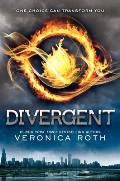 Decades ago our ancestors realized that it is not political ideology, religious belief, race, or nationalism that is to blame for a warring world. Rather they determined that it was the fault of human personality--of humankind's inclination toward evil, in whatever form that is. They divided into factions that sought to eradicate those qualities they believed responsible for the world's disarray. [...] Those who blamed aggression formed Amity. [...] Those who blamed ignorance became the Erudite. [...] Those who blamed duplicity created Candor. [...] Those who blamed selfishness made Abnegation. [...] And those who blamed cowardice were the Dauntless. (42-43)
Beatrice Prior, who grew up within the self-sacrificing Abnegation faction, has reached the age when she must make the biggest decision of her life. She, like all sixteen-year-olds in her post-apocalyptic Chicago, is evaluated to determine the faction for which she's best suited. While the evaluation results are stored, they do not determine placement. Using the evaluation as guidance, Beatrice must chose with which faction to ally herself. She'll still have to pass her chosen faction's initiation. If she doesn't, she'll spend the rest of her life as a
factionless on the outskirts of society.
On the day of her evaluation, Beatrice is unsure about which faction she'll choose. When her result is anomalous, Beatrice has more questions than before and only one day to make the decision. Beatrice goes with her gut and chooses Dauntless
2 despite the fact that her decision might mean that she'll never see her parents or brother again. The Dauntless initiation is much more intense than Beatrice, who renames herself Tris, imagined and the things she learns during it make her question the status quo.
I really enjoyed
Divergent (I assume that's obvious based on what I posted above) and, while it wasn't perfect, it didn't disappoint me. Readers don't receive any information about what big, apocalyptic event (if any) caused society to break down and reorganize in this way. They also don't learn anything about the world outside of Chicagoland.
3 This didn't bother me too much because it's quite possible given what we do know that the individuals living in Roth's Chicago have no contact with the outside world (if society even exists out there).
At first I thought that
Divergent would have been a stronger novel without Tris' blossoming romance. That it wasn't necessary. That Tris and the other character could have played off each other without their relationship developing into a romantic one. I thought it would have been better to leave this particular romance out or to leave it unstated and/or unrequited until later in the series (because, yes,
Divergent is the first in a series). But then I remembered the final scenes and I'm not sure how some of them would have played out if Tris and the other character hadn't been in love. I guess I'll just say--for the people like me who are tired of the "instalove" often portrayed in YA novels-- that Tris' romance is not quite of that ilk. They don't instantly fall for each other, there is tension, and they have much more in common than either of them realizes.
Tris is a relateable heroine, despite the fact that things sometimes seem too easy for her (and there is actually an explanation for that ease). The society Roth depicts is interesting and different than any other I've read thus far.
Divergent also works well as a first-book-in-a-series. There's world building and the revelation of an overarching storyline, but the novel has a satisfying conclusion. One of the areas in which
Divergent excels is in not getting bogged down in world-building and backstory.
Divergent is fast-paced and full of action. It is a bit heavy on the violence, but I think the story itself is so engrossing that even individuals who are sensitive about violence can push on past those sections.
Insurgent, the sequel to
Divergent will be released in May 2012. It's going straight on my wish list.
- Bumped by Megan McCafferty (see post) and Delirium by Lauren Oliver (see post).
- The encircled flame on Divergent's cover is the Dauntless seal. Though, I think that the stamped version on the hardcover itself is more striking than the burning image on the dust jacket.
- Chicagoland isn't a term used in the book. It's just an informal term for the Chicago metropolitan area. As far as I remember, Roth never names her imagined society.

 I'd been looking forward to the conclusion of Veronica Roth's Divergent Trilogy and was planning to order Allegiant when Russell informed me that I already had a copy on order courtesy of one of his sisters, who shopped my Amazon wishlist for my birthday. Safe in the knowledge that I'd be getting the new novel on the day it was released I set about rereading the first two installments in the series, Divergent (see post) and Insurgent (see post). I'd read Divergent at least twice so I remembered its twists and turns fairly well. Reading Insurgent was a bit more of a rediscovery for me since I'd only read it once before.

 Changeling — The child of a faery and a human, a changeling is small, sickly, and sharp-faced, and, if his faery-blood is particularly strong, he will have branches growing out of his head instead of hair. He is not expected to live past the age of twelve. [...] Half-bloods are forever being hung by the superstitious lower class, or stolen by the faeries who hate them for their ugliness. They spend most of their short lives locked-up and hidden away. (Bachmann's

 Considering how much I liked
  work colleague: So, what are you reading now?
 An e-audiobook from the library. (Ebooks I can probably take or leave, but e-audiobooks I love).
  I read, but never posted about
  Russell came back from the library one day and said that he'd seen a book he thought I might like, a history of Venice, but that he hadn't picked it up for me since he wasn't sure what my reading schedule looked like. My reading schedule, such as it is, is nothing but flexible and I love variety so I asked him to bring the book home next time he went to the library.
 From my dad's Amazon wishlist I selected,
  My mom received
  I'm loaning one of my new coworkers the
  Last year I read
  I've been in a book spiral for the
  I had to admit that while I've collected all the books in Lemony Snicket's
  While
While  I really enjoyed
  Historical romance set in Asheville, North Carolina circa 1899. Tillie is a senior parlormaid at Biltmore when she has a chance to become Mrs. Vanderbilt's ladies maid, position for which she's been groomed her entire life. Her priorities shift when Mack, twin of the undeniably handsome steward Earl, comes to live at Biltmore as a man of all work.
  I hadn't heard of
  Magdalena Haloway has grown up in a world that considers amor deliria nervosa, or more specifically how individuals infected with the disease act and react, the biggest threat to society. There is a cure, but it's risky to have the procedure performed too early. Boys and girls are segregated to reduce the likelihood of disease contraction in youth. As individuals near their eighteen birthday and cure date, they undergo an evaluation and receive a list of approved matches. Lena is counting the days until her procedure, looking forward to the safety it will provide. That is... until she meets Alex.
 I'd been wanting to read
  After a fire claimed the lives of both his parents, 12 year-old Will Henry became the unwitting apprentice of Dr. Pellinore Warthrop, his father's former employer. Dr. Warthrop is a monstrumologist, one who studies (and hunts) "life forms generally malevolent to humans and not recognized by science as actual organisms, specifically those considered products of myth and folklore" (
 16 year-old Emma Connor's life has been a bit of a disaster the past few years. First her twin brother dies (of meningitis), then her mother (of cancer), leaving Emma alone with her abusive, alcoholic stepfather. When her stepfather causes a car accident that nearly kills them both, Emma moves to New York City to live with her aunt Christine.
