Showing posts with label russell. Show all posts

Wednesday, July 25, 2012

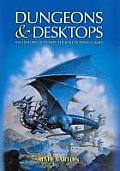
Dungeons & Desktops by Matt Barton

Dungeons and Desktops: The History of Computer Role-Playing Games
by Matt Barton


I haven't read Dungeons and Desktops, but it comes recommended by Russell, who has it checked out of our public library.  He's already foisted the book off on my gamer father.

As is painfully obvious from its subtitle, Dungeons and Desktops explores the history of the CPRG genre. Lest other gamers feel left out, the book does discuss console games and MMOs and how they are related to CPRGs.

Barton is an English professor by trade and Russell reports that Dungeons and Desktops is well-written, easy, engaging read. In addition to being informative, the book brought back lots of good memories of playing the games it discusses. He also appreciated that Barton fills out the story of the games, describing how the games were designed and who designed them.
Holy acronyms, Batman! (and lots more in the book)
CRPG: computer role-playing game.
MMO: massively multiplayer online [game].

Wednesday, August 17, 2011

dare I admit that there was another trip to Borders

Don't mock Russell. I encouraged him this time.

The Monday-Wednesday special this week was buy six, save an extra 10%, buy 8, save an extra 15%. It seemed like a good deal (provided the liquidator made good on it, unlike the last time) so we decided that Russell should go on a reconnaisssance and possible shopping mission today.

Russell made out pretty well and reported that it wasn't busy at all. He didn't even have to wait in line!

For me:
  • Bumped by Megan McCafferty (I've been dying to read this one)
  • Delirium by Lauren Oliver (on my 2011 challenge reading list assigned by Jessica)
  • Encounter by Milan Kundera (to complete my collection; I own everything Kundera's written that's available in English)
  • The Monstrumologist by Rick Yancey (because I'm not a fan of Simon & Schuster at the moment; see why)
For Russell:For both of us:Yes, that's a total of eight items. And, yes, we did get an extra 15% off.

Sunday, August 07, 2011

another trip to Borders, books found, and an idea

First of all, before I forget:
Those of you interested in the Borders liquidation might want to check out The Book Frog, who has been posting about her experience living through it. She's also gearing up to open an indy bookstore so her blog is very interesting reading.

We decided to run over to Borders on Thursday after work since the discounts had gone up (on Wednesday?) to 25-50%. Well, I didn't really want to go, but Russell did and I'd much rather go on a Thursday evening than on a busy weekend day. This time I actually prepared for the trip. I went over to my Amazon wishlist and made note of the current Amazon prices for some of the books on it.

Russell ended up buying two books -
1453: The Holy War for Constantinople and the Clash of Islam and the West by Roger Crowley from the history section. It was only 25% off, but the history section in our Borders was already decimated.
The Anti-Federalist Papers and the Constitutional Convention Debates by Ralph Ketcham at 40% off since it was housed in the politics section.

I didn't get anything. The prices on the knitting books (30% off) were still not as low as on Amazon. The general fiction/literature section was 30%, but again the prices on the majority of the books that were in stock were not competitive. YA books were only at 25% off (as were the genre fiction sections except romance, which was 40% off). At one point I had three books in my hands. Two were from my wishlist, while the third was one that just jumped off the shelf at me.

I put back the newly discovered book--The Map of Time by Felix J. Palma--first as it was hardcover with a high list price in addition to being an admittedly intriguing unknown entity. When we got home I looked it up. I'm happy I didn't get it at only 30% though since Amazon has it for 38% off.

The wishlist books--Shades of Grey by Jasper Fforde (which I reviewed in February after listening to an e-audio version from the library) and The Particular Sadness of Lemon Cake by Aimee Bender (which is a personally much-anticipated book club section for October)--were both general fiction trade paperbacks and were ever-so-slightly cheaper at Borders than on Amazon. I might have bought these two, but the longer I stayed in the store the more I felt irritated with the shopping experience (it was a bit zooy as they were closing early for inventory) and unable to justify spending the money given that there were more than one copy of each (2 of the one, 3 of the other) still in stock.

Also, I finished reading the book I bought during our first Borders liquidation trip (see post), The Girl in the Steel Corset by Kady Cross. I have to admit that I was disappointed in it. Not enough romance for a book published by Harlequin. Two different love triangles, but if I remember correctly only one kiss in the entire book. If there had been enough romance I might have been able to overlook the other problems I had with the book (two love triangles, far too much in the way of anachronism, the author always using the same adjective to refer to one of the character's hair, how the author skipped over the big action, etc).

I know many people are upset about the downfall of Borders and worried that their book-buying options will be limited. Yesterday as Russell and I were planning to visit a local used book shop (to check it out and see if we could pawn some of our weeded books off on them), an idea occurred to me. Russell and I will make an effort to visit local (and not-so-local) bookstores and then feature them on the blog. Expect to see the first of these features in the next week.

Sunday, July 31, 2011

Readings in American History

Today's tidbit comes from the War-on-Drugs era, more specifically from Mark Bowden's Killing Pablo (which is about the manhunt for Pablo Escobar).
The Americans were used to working with Colombian officers who would joke about failed missions, who took them no more seriously than getting the wrong order at a restaurant.
There were plenty of reasons why they repeatedly failed. On one occasion, approaching a suspect finca on a morning raid, the assault force lined up along a ridge and then simply walked toward the structure. A Centra Spike soldier accompanying them suggested that the force drop down on the ground and crawl.
"In the dirt?" asked a Colombian officer, insulted by the suggestion. "My guys don't crawl in the dirt and the mud."
The occupants of the target house fled well before the raiding party arrived. The finca had all the hallmarks of an Escobar hideout [...] The occupants had fled in such haste that they hadn't had time to completely burn documents, so they had urinated and defecated on them. This was enough to dissuade the national police from taking a look. When the Centra Spike man began to fish the papers out of the mess, the colonel himself objected.
"I can't believe you'd do that," he said. "That's human waste!"
"Where I come from we also low-crawl and get our uniforms dirty," the American said. (88)

Sunday, July 10, 2011

Readings in American History

Russell often reads me tidbits from the books he's reading. I've posted them occasionally in the past (the first that comes to mind ended up in my blogger profile), but today1 it occurred to me that maybe I should make these a more formal (if sporadic) feature. For now they'll be called "Readings in American History" (following my first-year humanities course at Chicago, Readings in World Literature). The title may change, but he's on an American (or at least North American) history2 reading kick right now so it should suffice for now.

A bit of Crucible of War: The Seven Years War and the Fate of Empire in British North America, 1754-1766 by Fred Anderson:
Of more immediate consequence for the governments of Pennsylvania and Virginia was an event that occurred not long not long after the [treaty] conference [at Logstown, PA in the spring of 1752] ended, two hundred miles farther west, at Pickawillany--the Miami town where George Croghan and his associates maintained their trading post. At about nine o'clock on the morning of June 21, 1752, a party of about 180 Chippewa and 30 Ottawa warriors, accompanied by 30 French soldiers from Detroit under the command of a French-Ottawa office named Charles-Michel Mouet de Langlade, attacked the settlement. Most of Pickawillany's men were away hunting; most of its women, who had been working in the cornfields, were made captive. After a six-hour attack, Langlade called a cease-fire. He would, he said, return the women and spare the defenders (who numbered only about twenty) if they agreed to surrender to the traders. Lacking any alternative, the defenders agreed, then looked on while the raiders demonstrated what the consequences of trading with the English could be. First they dispatched a wounded trader "and took out his heart and eat it"; then they turned their attention to the settlement's headman, Memeskia. This chief, known to the French as La Demoiselle, had lately acquired a new sobriquet, Old Briton, from Croghan and his colleagues. Now, to repay "his attachment to the English" and to acquire his powers for themselves, the raiders "boiled [him] and eat him all up." Then, with five profoundly apprehensive traders and a vast amount of booty in hand, they returned to Detroit. Behind them lay the smoking ruin that, twenty-four house earlier, had been one of the largest settlements and the richest trading point went of the Appalachians. (28-29)
This falls into the "weren't things great back then?" category.
  1. Incidentally, today's our anniversary.
  2. A Seven Years War / War of 1812 kick to be more precise.

Wednesday, October 03, 2007

The Day of Battle

Volume Two of the Liberation Trilogy, The Day of Battle: The War in Sicily and Italy, 1943-44 by Rick Atkinson

The Day of Battle is divided in to four parts. In the first part, Atkinson covers the Sicily campaign. In part two, he covers the British 8th Army invasion of Italy at the toe, the invasion of the American 5th Army at Salerno, and the Allies' battles at the Bernhardt Line centred around the town San Pietro. In the part three, he covers the failed attacks to capture of the town of Cassino and the abbey on Monte Cassino as well as the Anzio invasion and the German counter attacks on the beachhead. Finally, Atkinson covers the breakout at Cassino and the Anzio beachhead as well as the capture of Rome.

It is not necessary to have read the first book in the Liberation Trilogy, An Army at Dawn, to understand this second volume. If a person appears in the first volume, Atkinson reintroduces him in the second (though the information given at the introduction is not exactly the same).

When Atkinson writes about the battles, his descriptions are like better-written, less dry after action reports. He focuses the history on the command personal, the Allied and German generals (who he criticizes and praises equally); but he peppers that narrative with personal experiences from the enlisted ranks, lower ranked officers, and reporters showing how they viewed the events around them.

Atkinson ends the book at the traditional ending point of histories on the Italian campaign, with the fall of Rome. Only in the epilogue does he briefly cover the rest of the campaign until the war ends. This makes me wonder whether he will write about it the upcoming third volume. Atkinson already has a lot to cover in the third volume, starting with the preparations for D-Day, the Normandy campaign, the race across France, invasion of southern France, the Battle of Bulge and the fall of Germany; more, perhaps, that can be contained in one book.

This book is a great for what I call good general history, by which I mean that it gives a good overall history, but also has a bibliography that readers be used to learn more about the topic.

There are a couple small errors I noticed while reading The Day of Battle. On page 439, when Atkinson writes about monks of the Abbey of Monte Cassino contemplating the mysteries of the rosary, he includes the luminous mysteries, which were introduced Pope John Paul II. Additionally, on page 536, Atkinson refers to a historical battle occurring in the First Punic War with Hannibal, but Hannibal fought in Italy only in the Second Punic War.

My only other criticism is on how the references were handled in this book. Atkinson uses endnotes, which are grouped by page and marked by the first three words of sentences they are supporting. This made checking references slow and tedious; the reader can not see quickly the where the references are placed in the text. However, I really like the maps that are being used so far in this series.
On a small note, I finished this book on June 5th, the anniversary of the fall of Rome to the US 5th Army, the same point at which the book's narrative ends.

Reviewed by Russell Morse
I expect to be featuring Russell's reviews periodically on the blog (I've convinced him to start writing reviews), which should mix things up a bit as he tends to read different genres than I do.