Showing posts with label graphic novel. Show all posts

Saturday, January 18, 2014

Courtney Crumrin: The Night Things
by Ted Naifeh

source: purchased
Courtney Crumrin: The Night Things by Ted Naifeh
series: Courtney Crumrin Special Edition (1)
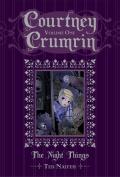
I purchased The Night Things last year at a local independent comic book/game shop (Modern Myths in Mamaroneck, NY) to read myself and then possibly send along to one of my nieces or nephews as appropriate. While I was immediately drawn to the Courtney Crumrin books (it seems like each of these hardcover special editions collects four issues of the comic) as the covers showcase Naifeh's characteristic gloomy artwork and are nicely tactile, but I held out for quite a while before I actually handed over my money.

I decided to read The Night Things last night as I needed a break from my regularly-scheduled flu reading (Terry Pratchett's Tiffany Aching Adventures; I'm on the third installment now). I have to admit, though, that I was a bit underwhelmed by it.  When collected together the story seems disjointed in a way that it wouldn't when read in its original format.  And, I wished there was more character development specifically with regard to Courtney's relationship to Aloysius. I will, however, give The Night Things another chance since it's quite likely that I'll be less critical when I'm not feeling so poorly.

Monday, December 26, 2011

books, giving and receiving


There were only three books among my outgoing holiday gifts this year.  I did not purchase any books for Russell since we went a bit overboard with book buying this year (remember Borders?).

From my dad's Amazon wishlist I selected, The Transformation of Bartholomew Fortuno by Ellen Bryson.
My mom received Betty Crocker's Best Bread Machine Cookbook to go along with her new bread maker (a gift from my dad). My mom is going to be doing a lot of experimenting with ingredient substitutions to I chose this book in particular because of a section it has on problem-solving, which is full of illustrations. Two other things in its favor: overwhelmingly good reviews and a structure that enables it to lie flat.

I got my sister a copy of The Hunger Games.
She wasn't particularly enthused, but I reminded her about how miffed she was with me when Twilight (the film) was released for not having previously informed her about the existence of the Twilight Saga.
Now, I legitimately thought she would refuse to read Twilight given its slow pacing and her general dislike of vampires and I don't even like the series (my ambivalence turned to hatred after Breaking Dawn).
Since The Hunger Games is coming out next year and I love Suzanne Collins' trilogy, I thought it would be irresponsible of me not to get her a copy of the book.

I received three books this year (all from Russell)
I really wasn't expecting books, but I have to say that I was tickled pink to get the two novels as they were among my most wanted books.

Thursday, June 24, 2010

book clubbing in June (1 of 2)

Graphic novel month for the library book club...

Castle Waiting by Linda Medley

We read the first collection of Linda Medley's Eisner Award-winning comic-book series, Castle Waiting. I had to rush through it a bit as I didn't get my hands on a copy until last Monday (book club meeting was on Wednesday), but I enjoyed it nevertheless. And, I'm happy to report that the general consensus of book club members was positive as well.

Castle Waiting begins with a retelling of Sleeping Beauty. After the princess awakes, she runs off with her prince leaving her castle waiting for new tenants. The castle becomes well-known as a refuge and the series follows the stories of the individuals who find their home in it.

Castle Waiting is full of literary references both overt and subtle. As I was reading I kept thinking that I wasn't catching everything making me think that the volume could stand up to many rereadings.

The collected volume ends at a bit of a weird place, leaving it unbalanced as a stand-alone: far too of the narrative is spent on the backstory of one of the characters. That being said, full backstories of the other characters should be forthcoming in the next volume.

I was intrigued by the order of bearded nuns (apparently this idea has some basis in history) and by Lady Jain (I really wanted to know more about her and how she came to be in the situation she was in). I loved the little hobgoblins that infested the castle (especially the one that looks after the baby).

My biggest complaint had to do with the format. The pages were shrunk down to fit into a binding that looks very much like one of the Series of Unfortunate Events books (evident from the image I chose for this post). Our resident graphic novel expert brought his copies of the Castle Waiting comics and flipping through them I realized just how much the reduced page and panel size changed the experience of reading the story.

Thursday, February 04, 2010

The Professor’s Daughter

The Professor’s Daughter
by Joann Sfar and Emmanuel Guibert


Set in Victorian London, The Professor’s Daughter is the story of a 3,000 year-old mummy who falls in love with the daughter of the academic who’s studying him. The affair between Lillian Bowell and Imhotep IV seems ill-fated, not because Imhotep IV is a mummy, but because he falls on the wrong side of the law… among other things.

The Professor’s Daughter is a comedic romp that’s at times quite serious. A joy to read; its artwork is truly lovely, the sepia tones giving the story a real period feel.

Friday, October 30, 2009

Friday Find #9

We discussed a graphic novel at our book club meeting on Wednesday (see post). One of our members listened to Nancy Pearl's September podcast on graphic novels prior to the meeting and brought with her a list of the books mentioned in the episode. One in particular jumped out at me...

Stitches by David Small

One day David Small awoke from a supposedly harmless operation to discover that he had been transformed into a virtual mute. A vocal cord removed, his throat slashed and stitched together like a bloody boot, the fourteen-year-old boy had not been told that he had throat cancer and was expected to die.

Small, a prize-winning children's author, re-creates a life story that might have been imagined by Kafka. Readers will be riveted by his journey from speechless victim, subjected to X-rays by his radiologist father and scolded by his withholding and tormented mother, to his decision to flee his home at sixteen with nothing more than dreams of becoming an artist. Recalling Running with Scissors with its ability to evoke the trauma of a childhood lost, Stitches will transform adolescent and adult readers alike with its deeply liberating vision.


Holy moly! this sounds both horrible and fascinating. I'm hoping our library's graphic novel collection has a copy so I can check it out.

Thursday, October 29, 2009

book clubbing in October

Box Office Poison by Alex Robinson

I wasn't sure how Box Office Poison would go over with the book club considering the fact that we universally disliked our last graphic novel selection (Why I Hate Saturn, see post) and the amount of naked man flesh in Box Office Poison, but I was pleasantly surprised to find that almost everyone at least kind of liked it.

Originally published serially, Box Office Poison is a 600+ page behemoth of a graphic novel. Readers can easily plow through it, but I really do think it would be easier to appreciate if read in installments.

On his blog Robinson shares quite a bit of commentary on
Box Office Poison, which makes for very interesting reading. I think an annotated version of Box Office Poison would be fantastic because there's just so much that readers might not catch as they are reading it.

During our discussion we talked about which characters we liked and disliked, the storyline about Irving Flavor and what it told us about the comic industry, the various characters' happy and not-so-happy endings, the two homeless girls and what their role was in the story arc, Box Office Poison's target audience, and the similarities between Eddie and Robinson (at least how they are drawn), among other things.

Wednesday, September 16, 2009

book club voting lists (2 of 4)

This post explains what the lists are all about...

General Nonfiction:
  1. The Botany of Desire: A Plant's-Eye View of the World by Michael Pollan
  2. City on the Edge: Buffalo, New York, 1900-present by Mark Goldman
  3. Confederates in the Attic by Tony Horwitz
  4. The Devil's Highway by Luis Alberto Urrea
  5. Dewey: The Small-Town Library Cat Who Touched the World by Vicki Myron
  6. The Ghost Map: The Story of London's Most Terrifying Epidemic--and How It Changed Science, Cities, and the Modern World by Steven Johnson
  7. The Golden Spruce: A True Story of Myth, Madness, and Greed by John Vaillant
  8. The Lost City of Z: A Tale of Deadly Obsession in the Amazon by David Grann
  9. Once Upon a Quinceañera: Coming of Age in the USA by Julia Alvarrez
  10. Outcasts United: A Refugee Team, an American Town by Warren St. John
  11. The Platypus and the Mermaid: And Other Figments of the Classifying Imagination by Harriet Ritvo
  12. Rumspringa: To Be or Not to Be Amish by Tom Shachtman
  13. The Science of Sherlock Holmes by E.J. Wagner
  14. Stiff: The Curious Lives of Human Cadavers by Mary Roach
  15. Under the Sabers: The Unwritten Code Of Army Wives by Tanya Biank
Graphic Novels:
  1. American Born Chinese by Gene Luen Yang
  2. Blankets by Craig Thompson
  3. Castle Waiting by Linda Medley
  4. A Drifting Life by Yoshihiro Tatsumi
  5. Kings in Disguise by James Vance and Dan Burr
  6. The Lagoon by Lilli Carré
  7. Laika by Nick Abadzis
  8. Our Cancer Year by Harvey Pekar
  9. Pride of Baghdad by Brian K. Vaughan, Niko Henrichon
  10. The Professor's Daughter by Joann Sfar and Emmanuel Guibert
  11. Strangers in Paradise by Terry Moore
Historical Fiction:
  1. Beneath a Marble Sky by John Shors
  2. The Constant Princess by Philippa Gregory
  3. The Day the Falls Stood Still by Cathy Marie Buchanan
  4. In the Beauty of the Lilies by John Updike
  5. The Master by Colm Toibin
  6. Peony in Love by Lisa See
  7. The Physick Book of Deliverance Dane by Katherine Howe
  8. Pope Joan by Donna Woolfolk Cross
  9. The Remedy by Michelle Lovric
  10. Remembering Babylon by David Malouf
  11. Tears of Pearl by Tasha Alexander

Thursday, September 03, 2009

Fun Home

Fun Home: A Family Tragicomic by Alison Bechdel

Dykes to Watch Out for author Alison Bechdel's brutally honest memoir, Fun Home, focuses on her childhood and coming-of-age. The "fun" in the graphic novel's title is both a shortening of funeral (the family runs a funeral home) and wonderfully sarcastic (her home was such a fun place to grow up).

Fun Home is as much about Bechdel growing up and developing her sense of self as it is about her relationship with her father. His untimely and somewhat suspicious death makes her father even more of an enigma and Bechdel struggles to understand both him as a person and how much she had in common with him.

One of the things I like about Fun Home is how literary it is, literary in a very accessible way. Bechdel references both well- and lesser known works of literature and uses lots of uncommon words. She also does things like this bit I photographed from page 106

(click on the image to bring up a larger, more legible version), which follows a panel depicting Bechdel and some of her lesbian friends stopping by a bar in Greenwich Village called Chumley's.

Thursday, May 07, 2009

Booking Through Thursday - Graphic

Last Saturday (May 2nd) was Free Comic Book Day! In celebration of comics and graphic novels, some suggestions:

- Do you read graphic novels/comics? Why do/don’t you enjoy them?

I do read graphic novels, though not all that often.

- How would you describe the difference between "graphic novel" and "comic"? Is there a difference at all?
My sense has always been that a graphic novel is novel-like narrative told in comic form. Comic strips are what appears in the Sunday newspaper. Comics are the serials that people buy at comic book stores (new issues show up on Wednesdays, I believe). I don't really consider previously published comics collected and republished in a book form a graphic novel, despite the fact that the comic industry tends to refer to these collections as graphic novels.

- Say you have a friend who’s never encountered graphic novels. Recommend some titles you consider landmark/"canonical".

I'd usually say Maus (I recently re-read the books and posted about them), though I've also recommended Ethel & Ernest, Persepolis, and Joann Sfar's books depending on who's asking.

ETA: Lockwood also has a nice graphic novel collection, all housed together and easy to browse. When talking to people on campus about graphic novels, I point them in that direction. I've also been making use of the collection myself. Right now I have Fun Home by Alison Bechdel checked out.

Monday, May 04, 2009

Maus

Maus, A Survivor's Tale by Art Spiegelman

Together Maus I and Maus II are both the story of a Holocaust survivor and the story of a writer/artist trying to tell that story.

I'd read the books years ago as a young adult (probably 2 or 3 years after they were first published) and I remembered them, but only vaguely. One of the things I did not remember was the dynamic between Artie and his father. I think in some ways it must have been just as hard for Spiegelman to be honest about his relationship with his father as it was to tell his father's story.

Another thing I didn't remember was how Spiegelman portrayed the other nationalities in the book. I remembered the cats and mice, but not the Poles as pigs, Americans as dogs, etc.

The books are poignant and what strikes me the most about them is how honest they are. Honest about the Holocaust and all its atrocities, honest about the father and son relationship, and honest about the author and his own failings.

Wednesday, November 19, 2008

book clubbing in November

I feel like this post should be titled "Why We Hated Saturn". Not that we (meaning the book club) hated Why I Hate Saturn. Hate is really much too strong of a word for our reaction to the graphic novel, it just makes a wonderful play on the title.

In any case, this month was another graphic novel month for my book club. Kyle Baker's Why I Hate Saturn was our topic and we were generally not crazy about the book.

Personally I liked the idea of the crazy sister from Saturn, but thought that Baker could have done more with that aspect of his story. And, I think the cover is fantastic. I just wish that the novel itself was more like what I expect from seeing the cover.

Overall we thought the story was a bit lacking with regard to the plot. We also found it jarringly disjointed (would we have liked it better if we'd read each section as a snippet like serial cartoons?). We also thought that the author - in this book - did not take full advantage of the genre. One of the attendees hit it on the head, I think, when he said that the panels were mostly "talking heads". Additionally, we thought that the protagonist wasn't a very convincing woman (a classic example of a man creating a female character and just not quite getting "it").

We did, however, universally like the section titles. The book also engendered a good conversation about the genre in general and about specific titles that individual attendees thought were good examples (or thought others would like).

Friday, September 19, 2008

Ethel & Ernest

Ethel & Ernest by Raymond Briggs

Ethel & Ernest: A True Story is a graphic novel that relates the story of the author’s parents from their first meeting in 1928 to their deaths in 1971. Winner of the British Book Awards’ Best Illustrated Book of the Year for 1999, Ethel & Ernest is a touching memorial. It is also an interesting social history, showing how one working-class family confronted the Great Depression, World War II, and the great social and technological changes during this time period.

Read more on the Student Services blog...

Wednesday, June 25, 2008

Book clubbing in June

This month's book club selection wass the 2008 Caldecott Medal winner, The Invention of Hugo Cabret by Brian Selznick.

Though it is 500+ pages, The Invention of Hugo Cabret is a very quick read. It's not a graphic novel, but rather a novel that takes a cue from film and uses image sequences (in the form of detailed line drawings, also by the author) to further the plot.

I don't really want to get into plot since the story itself isn't very long. Selznick clearly put a good deal of thought and time into the book. It's very clever and there's a wonderful sense of interconnectedness to it.

One of the book club members checked an audio version out of the library (in the audio version the image sequences are replaced by realistic sound sequences) that came a bonus DVD. We watched part of it and had a chance to listen to the Selznick discuss about the book, how he came up with the idea(s) for it, and a lot of the historical background to it and that really did give most of us a new appreciation for the book.

As a group we thought that The Invention of Hugo Cabret was equally appropriate for children/YA and for adults. We appreciated the fact that the story revolved around a historical personage and how it taught us as readers about the history of film without being too obvious about it.

My only complaint is that the story itself was so short. I wished it would have been a bit meatier, taken a bit longer to read.

Wednesday, December 19, 2007

book clubbing in December

Because the Libraries' holiday party was scheduled for today, our book club meeting was rescheduled for Thursday of last week. Voting for our 2008 and 2009 selections is going on right now - so exciting - so expect that list to be posted sometime in the middle of next month (the results of our last round of voting are listed in this post).

In any case, our selection for this month was Persepolis: The Story of a Childhood by Marjane Satrapi.
Persepolis is Satrapi's wise, funny, and heartbreaking memoir of growing up in Iran during the Islamic Revolution. In powerful black-and-white comic strip images, Satrapi tells the story of her life in Tehran from ages six to fourteen, years that saw the overthrow of the Shah's regime, the triumph of the Islamic Revolution, and the devastating effects of war with Iraq. The intelligent and outspoken only child of committed Marxists and the great-granddaughter of one of Iran's last emperors, Marjane bears witness to a childhood uniquely entwined with the history of her country.
I was excited to read the book because I've had Persepolis 2: The Story of a Return (rescued from the bargain bin at a local independent bookstore) on my shelves for a while without a good excuse to pick up the first book.

Persepolis was a relatively quick read, but one that bears re-reading. I really appreciated how Satrapi's drawing style complimented the subject matter (expressive, but spare so as to not overwhelm the actual story she was telling). Probably my favorite part of the book was Marji's relationship with God and how it is depicted.

For some of the people in our book club, this was their first experience with graphic novels. A librarian who specializes in graphic novels was in attendance so he ended up leading the discussion. And, while there is much to discuss in the book itself, we ended up talking mostly about graphic novels in general.