Friday, May 20, 2011

a juicy find

This week as I was browsing the State University of New York Press catalogs, I came across a particularly juicy title from their Excelsior Editions1 and I just had to share.

Arsenic and Clam Chowder by James D. Livingston
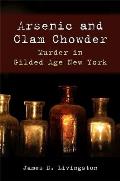
Arsenic and Clam Chowder recounts the sensational 1896 murder trial of Mary Alice Livingston, a member of one of the most prestigious families in New York, who was accused of murdering her own mother, Evelina Bliss. The bizarre instrument of death, an arsenic-laced pail of clam chowder, had been delivered to the victim by her ten-year-old granddaughter, and Livingston was arrested in her mourning clothes immediately after attending her mother’s funeral. In addition to being the mother of four out-of-wedlock children, the last born in prison while she was awaiting trial, Livingston faced the possibility of being the first woman to be executed in New York’s new-fangled electric chair, and all these lurid details made her arrest and trial the central focus of an all-out circulation war then underway between Joseph Pulitzer’s World and Randolph Hearst’s Journal.
The story is set against the electric backdrop of Gilded Age Manhattan. The arrival of skyscrapers, automobiles, motion pictures, and other modern marvels in the 1890s was transforming urban life with breathtaking speed, just as the battles of reformers against vice, police corruption, and Tammany Hall were transforming the city’s political life. The aspiring politician Teddy Roosevelt, the prolific inventor Thomas Edison, bon vivant Diamond Jim Brady, and his companion Lillian Russell were among Gotham’s larger-than-life personalities, and they all played cameo roles in the dramatic story of Mary Alice Livingston and her arsenic-laced clam chowder. In addition to telling a ripping good story, the book addresses a number of social and legal issues, among them capital punishment, equal rights for women, societal sexual standards, inheritance laws in regard to murder, gender bias of juries, and the meaning of “beyond a reasonable doubt.”

Arsenic and Clam Chowder doesn't seem like typical university-press fare, but it is written by a member of the academy (albeit a physist and engineer who happens to be an amateur historian). And it fits into the Excelsior imprint since the Livingstons are a prominent New York family.

I'm not particularly keen on the cover art (though I'll allow that it may look better in person that it does online), but the story is quite compelling, is it not?
  1. Excelsior Editions is an imprint devoted to the history, culture, society, and environment of New York and its surrounding states.
    On a side note: excelsior is the motto of New York state (featured on the state seal and all); it means "ever higher."

follow friday question

My second week for this meme.

It's circle time. Time for us to open up and share. Can you tell us FIVE quirky habits or things about you? We all have them...
  1. When I was younger I used to dye my hair all kinds of crazy colors (and I mean bleaching my hair white first to get really bright color). People who've met me as an adult have a hard time believing this. My very conservative father quite liked the purple and took to calling me Princess Grape when I had purple hair.
  2. I own a typewriter. I rarely use it, but I was horrified when Russell wondered if maybe me shouldn't get rid of it during our pre-move purge. I actually learned to type on a typewriter, though I'm don't know how soon after the school switched over to using computers for keyboard training.
  3. A blogging-related quirk is that I'm much more of a lurker than a commenter and I'm trying to rectify that. I have tons of blogs in my reader, but there are quite a few that I've probably never interacted with in such a way that the author actually knows that I'm an active reader.
  4. My husband has five sisters (five!) and they all have names that begin with the letter K. None of them is named Karen so I fit right in.
  5. I'm ichthyophobic (I won't give you the definition; if you want to know, go look it up).
If you are visiting this blog for the first time, welcome! This is Karen. I'm a librarian and archivist and I've been writing this blog since 2006. Some of my favorite books are All We Know of Love (schneider), The Book of Laughter and Forgetting (kundera), The God of Small Things (roy), The Handmaid's Tale (atwood), Pride and Prejudice (austen), The Storyteller (vargas llosa), and Zahrah the Windseeker (okorafor-mbachu).

Here are my five most recent posts:I usually write posts that focus on an individual title, but this past week was a bit abnormal. Any questions? Feel free to ask.

Wednesday, May 18, 2011

Philip Roth

Announced today: American author Philip Roth is the winner of the 2011 Man Book International Prize.

The international prize is different from the normal Booker in that it recognizes a writer's oeuvre,1 rather than an individual novel. A relatively new award, the international prize is awarded every two years. The previous winners are Chinua Achebe (2007), Ismail Kadare (2005), and Alice Munro (2009).

I'm a bit embarrassed to admit that I haven't read much Roth. Of his more recent novels, I've only read The Plot Against America, which I loved.2 Nemesis is on my list as a must-read for both me and my mom.

The other contenders for this year's prize:I'm unfamiliar with a few of these authors, which is something that needs to be rectified.

Image (c) Nancy Crampton
  1. oeuvre: the lifework of a writer, artist, or composer. We get this lovely word from the French; it descended from the Latin opus.
  2. I actually wrote a paper for an early American literature class comparing The Plot Against America to Hope Leslie by Catharine Sedgwick. Another aside. I ended up in this class because one on literature of the diaspora had been canceled and I was bound and determined to take something after all the hoops the department made me go through in order to register for a graduate-level course as a faculty member (seriously it was like applying to a PhD program; I even had to get letters from former professors and submit a writing sample).

Tuesday, May 17, 2011

reading habits survey

I found this set of questions at Pretty Deadly Reviews and thought it might be interesting to do.

Do you snack while you read? If so, favourite reading snack?
Sometimes. I don't make a habit of it, but I will continue to read while I'm eating a snack. There's no particular food that I tend to eat while reading.

Do you tend to mark your books as you read, or does the idea of writing in books horrify you?
If you consider the fact that I'm a librarian, you'd think I'd be horrified by the idea of writing in books. But, it really doesn't bother me much, in fact the majority of the books I read in college and graduate school are full of underling and marginalia. I've also been known to dog-ear (horror of horrors!) when I don't have a bookmark on hand. Now, I would do such things to a library book or a book that was loaned to me. Such treatment is reserved for my own books.

How do you keep your place while reading a book? Bookmark? Dog-ears? Laying the book flat open?
Well, I already confessed to dog-earring above. I prefer to use a bookmark (or the flap of the dustjacket), but I do dog-ear and I do lay books face-down if they can handle it (ie. I don't break spines just so I can save my place). Russell find the face-down book-leaving particularly vexing and is liable to try to make me feel guilty about it, but I caught him doing it this weekend.

Fiction, Non-fiction, or both?
Both, but primarily fiction.

Hard copy or audiobooks?
Any and all. I like audiobooks for knitting and long car trips. I have a Nook and am now fine with reading e-books (something to which I really wasn't sure that I'd be open). I prefer to have hard copies of my favorite books (hardcover when possible as they hold up better than perfect-bound paperbacks) so I can easily reread them.

Are you a person who tends to read to the end of chapters, or are you able to put a book down at any point?
I prefer to leave off at the end of a chapter. I've been like that since I was a child ("just one more chapter, Mom, then I'll go to sleep"). But, I will leave off mid-chapter if necessary.

If you come across an unfamiliar word, do you stop to look it up right away?
Not usually. In most cases you can get a general idea of a word's meaning when seeing it in context. Sometimes I will mark the page with an unfamiliar (or one you don't often see or one that is particularly interesting) so I can look it up later and possibly feature it on this blog. (see featured-word posts)

What are you currently reading?
  1. Mercy by Rebecca Lim (forthcoming)
  2. Museum Archives: An Introduction edited by Deborah Wythe
  3. Original Knickerbocker: The Life of Washington Irving by Andrew Burstein
  4. Possessions: The History and Uses of Haunting in the Hudson Valley by Judith Robinson
  5. Steampunk! An Anthology of Fantastically Rich and Strange Stories edited by Kelly Link and Gavin Grant (forthcoming)
  6. Tiny Sunbirds, Far Away by Christie Watson
What is the last book you bought?
Well I'm not supposed to be buying new books.
Before I moved I received a couple of Amazon gift cards, which I used to get a Mortal Instruments box set containing City of Bones, City of Ashes, and City of Glass all by Cassandra Clare.
I still have $90-something left, but I'm not sure what I'll spend it on.

Are you the type of person that only reads one book at a time or can you read more than one at a time?
As should be obvious from one of my answers above, I like variety so I'm often reading more than one book at a time. I don't usually have quite so many books going at one, but three or four is pretty standard. I've been trying to keep that sidebar section up to date so you can always check there to see what I'm working my way through.

Do you have a favorite time of day and/or place to read?
A favorite time of day to read I don't have. I read all the time, though mostly in the evenings as that's when I tend to have the time.
I usually have a book on hand (I keep one in my purse just in case), but I prefer -- at least at this point in my life -- to read at home. Since we're still unpacking and there are boxes everywhere I haven't yet decided on my favorite spots.

Do you prefer series books or stand alone books?
I read both. I probably read more stand-alone books because there are more of them out there, but some of my favorite books are installments in a series.

Is there a specific book or author that you find yourself recommending over and over?
Since I've read Suzanne Collins' Hunger Games trilogy (Hunger Games, Catching Fire, Mockingjay), I've recommended it quite a bit.

Others frequent recommendees (yes, I know that isn't a word) include The Handmaid's Tale by Margaret Atwood, anything by Jasper Fforde, and Zahrah and the Windseeker by Nnedi Okorafor-Mbachu.

All We Know of Love by Katie Schneider is one of my favorites, but I don't often give it as a recommendation (see this post for why).

How do you organize your books? (By genre, title, author’s last name, etc.?)
That is something that we need to work on in our new space and I will post when I figure it out. At our old place my books were pretty organized categorically: bookcrossing books, knitting books, all others.

Monday, May 16, 2011

Washington Irving Book Awards

Last Friday I attended part of the Westchester Library Association conference and its Washington Irving Book Award event.

The Washington Irving Book Award (given biennially) honors books by Westchester authors for books published in the past two years. Books are vetted by a committee of librarians based on readability, literary quality, and wide general appeal.

The event included Jonathan Kruk as Washington Irving, short speeches by the award-winning authors, Q&A, and book-signing.

Seth Godin (Linchpin) was persona non grata after his lunchtime presentation on the future of libraries so he didn't stick around for the award event (I guess librarians are as resistant to change as everyone else).1 There were a few other winners that weren't at the award ceremony.2 I hope they had good excuses because each of them now has a black mark in my book.

Quite a few of the authors in attendance adapted their speeches because they felt the need to respond to Godin and nearly all of them shared their feelings about libraries and librarians. I left the room wanting to read all the books (even those I wouldn't normally consider) because the authors were charming and appreciative.

I do have to say that my favorite part of the event was during the question-and-answer period when someone asked about where the authors worked. Each author answered in turn and their responses were diverse (though apparently Jonathan Tropper and Jeff Pearlman fight over a table at the Cosi in New Rochelle). Right after the last award-winning author responded, Kruk/Irving popped up and explained his writing habits. It was a lovely surprise and made everyone grin.

Now without further ado, here are the award-winners (minus the absentees):

Fiction:
  • Diamond Ruby by Joseph Wallace
    At the research library at the Baseball Hall of Fame Wallace came across a photograph of a teenage girl in uniform shaking hands with Babe Ruth (Lou Gehrig standing by). That girl was baseball phenom Jackie Mitchell, who it seems is the reason that women were banned from professional baseball in the 1930s and she was in the inspiration for Diamond Ruby, the author's first novel (he's written nonfiction in the past).
  • In the Shadow of Gotham by Stefanie Pintoff
    Another debut novel. Pintoff's protagonist, detective Simon Ziele, leaves Little Germany in the wake of the General Slocum disaster to settle in Dobson (a fictional town that's a bit of Dobbs Ferry, Hastings, and Irvington) only to have his peace shattered by a brutal murder nearby. Apparently In the Shadow of Gotham is full of period detail and highlights early criminology.
  • The Man Who Never Returned by Peter Quinn
    The sequel to The Hour of the Cat, The Man Who Never Returned follows the investigation into inexplicable 1930 disappearance of NYC judge Joe Crater.
  • Scared to Death by Wendy Corsi Staub
    The sequel to Live to Tell; a thriller. Don't read the Publishers Weekly review as it seems to give away far too much about the plot.
  • This is Where I Leave You by Jonathan Tropper
    Judd's perfect life comes crashing down when he loses his job and wife in the same day (yep, his wife's sleeping with his boss). To make matters worse his father dies the same day and he's stuck sitting shiva with his unbearable family. It's going to be a long seven days.
Nonfiction:
  • American Passage: The History of Ellis Island by Vincent Cannato
    An engaging history of Ellis Island from a University of Massachusetts at Boston professor (does he live in Westchester when school's not in session?).
    It seems like Cannato tries to bridge the gap between popular history and the academy.
  • Closing Time: A Memoir by Joe Queenan
    One of the things Queenan said in response to Godin's talk was "the Visigoths and Huns will always be at the gates, but I don't see why we should invite them in" (that quote's from memory so it may not be 100% accurate).
    In Closing Time he writes about growing up in a Philadelphia housing project.
  • Frank: The Voice by James Kaplan
    A biography of Frank Sinatra
  • Imperial Cruise: A Secret History of Empire and War by James Bradley
    Bradley's father was one of the guys immortalized in the Iwo Jima Memorial, but he never talked about what happened in Iwo Jima. Bradley's desire to research and share that story is what started his writing career.
    This book looks a bit further in the past to Theodore Roosevelt and the US's early involvement in Asia.
  • The Rocket that Fell to Earth: Roger Clemens and the Rage for Baseball by Jeff Pearlman
    I wouldn't normally think of picking up a book like this, but Pearlman won me over when he spoke about a disastrous book-signing he had at Fort Hood.
  • This Book is Overdue: How Librarians and Cybrarians Can Save Us All by Marilyn Johnson
    This is exactly the kind of book that goes over well with librarians.
  • Walking Papers: The Accident that Changes My Life and the Business that Got Me Back on My Feet by Francesco Clark
    After hearing Clark speak I have no doubt that this is an inspirational book. I am particularly impressed with the fact that he didn't use his speech as an opportunity to talk about his company.3 He spoke exclusively about his injury, his path to recovery, and how he came to write the book and he's the only one of the author's who got cut off by the moderator.
I haven't spent any time looking into the past winners of the award so I don't know whether the book's chosen this cycle are typical or not, but I have to say that I was struck by a lack of diversity in the fiction winners. We have non-genre fiction, historical fiction, and mystery/thrillers. I can see sticking to more serious fiction for awards, but if you are going to include allow truly popular fiction then I think you need to be open to all genres. I can't believe that there no Westchester authors who write romance or science fiction, horror or fantasy.

ETA: I didn't pick up a copies of any of the books since I'm currently on book acquisition ban (see post) and, believe me, there were quite a few that I was dying to bring home with me.
  1. While I didn't agree with everything that Godin said (I just can't go all the way and say Wikipedia is a-ok for school kids; I still think everyone needs to learn about the importance of evaluating sources), I do agree that the library as we know it is on its way out and that we need to adapt in order to survive.
  2. Don Delillo (Point Omega), Andrew Gross (Reckless), Scott L. Malcomson (Generation's End), and Cynthia Ozick (Foreign Bodies).
  3. He mentioned it (I think he had to say something about it because it's in the title of his book), but I didn't know why he started a skincare line until I looked up a detailed synopsis of his book.

Sunday, May 15, 2011

Skylark Farm

Skylark Farm by Antonia Arslan
translated by Geoffrey Brock


Winner of the 2004 Premio Campiello (a prestigious Italian literary prize), this debut novel by a former professor of modern and contemporary literature at the University of Padua tells the story of one family during the 1915 Armenian genocide in Turkey.

Based on the author’s own family history, Skylark Farm is written with immense sensitivity. The author treats the subject as well as her readers with care, ever mindful of their tolerance for violence. One of the things that makes the novel stand out is that despite the horrific subject matter, Skylark Farm also manages to be part adventure story as it chronicles the escapades of the family’s would-be rescuers.
disclosure: I received an advanced copy of this book to review for Library Journal when the book came out a few years ago. As far as I know the review never appeared in periodical.

Saturday, May 14, 2011

on weeding our book collection (post 1 of ?)

We've just moved. We're still in the process of unpacking. Moving is really not my favorite thing to do.

Russell and I both freely admit that we have a bit of a book-collecting problem.1 Our books were here there and everywhere in our old place. Many were packed away in boxes and we had bookcases packed in most cases two books-deep nevertheless we had freestanding piles. I refuse to let things continue that way in the new place.

I want books to be on bookcases and organized in such a way that we can actually find something when we want to read it. And, I'm willing to weed mercilessly in order to make that happen.

I did get rid of around 300 books (mostly to a book drive) before we left, but I still have far too many. I'm trying to weed as we unpack book boxes. I've come up with some general rules for myself and I'm trying (though not always succeeding) to be ruthless.

If I've already read a book, I'll only keep it if I genuinely think I'll reread it or if I need to have it around for reference.
When I encounter a to-be-read book, it will only be kept if it meets one of the following conditions:
  • It's a classic that I really do need to get around to reading.
  • I remember its premise and am still interested.
  • Its synopsis appeals to me right now.
  • It came highly recommended from someone whose opinion in books I trust implicitly.
Of course I've kept some books because I liked their titles (Geographies of Home by Loida Maritza Perez) or they were written by an author whose work I've enjoyed in the past (Surfacing by Margaret Atwood) or because it's related to my job (a bunch of the books from oral history class I took in grad school) or any number of other (il)logical reasons. Regardless, I am making progress.
  1. I have to say that at least on my part BookCrossing is partly to blame. When I decided to participate I thought it'd be a good way to get rid of books. It was in fact a catalyst for book acquisition. I started picking up free or unbearably cheap books to bookcross, there are affiliated sites that aid in the trading of bookcrossing books, and once people knew that bookcrossing was something I did they gave me books they no longer wanted so that I could bookcross them. The problem was that often these books never left the apartment, even those acquired expressly for bookcrossing.

Friday, May 13, 2011

follow friday question

My second week for this meme.

What is the most emotional scene in a book that you have read lately?

Probably the death of George in White Woman on the Green Bicycle by Monique Roffey (review forthcoming). Many of the scenes with Abram in The Unthinkable Thoughts of Jacob Green by Joshua Braff (post) were pretty difficult in a different way (Abram is verbally and emotionally abusive).

Thursday, May 12, 2011

books from the library shelves: American Writers at Home


William Faulkner’s study at Rowan Oak.
The writing on the walls is an outline for Faulkner's
Pulitizer Prize- and National Book Award-winning A Fable.

American Writers at Home by J. D. McClatchy
Photographs by Erica Lennard
"This is not a book about writers, or about houses, or about America. It is a book about where and why and how American writers made a home for themselves--a place to live, yes, but above all a place to work—in a restless, rugged country" (McClatchy's introduction)1
Featuring 300 lush and lovely full-color photographs of the homes of 21 American writers American Writers at Home is a glorious, yet substantive coffee-table book.

Like all (most?) coffee-table books, American Writers at Home inspires multiple visits rather than a cover-to-cover read. Readers will love seeing the space their favorite writers inhabited and hearing the author's take on how each of the authors' environments inspired them. American Writers at Home may also inspire some literary pilgrimages as all of the properties featured in the book, with the exception of Edna St. Vincent Millay's Steepletop, are open to the public.

While McClatchy does include a mini bibliography for each author/house at the end of American Writers at Home, he fails to provide references for individual quotes. This isn't a scholarly text, but the lack of citation drives me crazy and is probably the one thing that I do not like about this book.

One of the sites featured is Washington Irving's Sunnyside. McClatchy says of Sunnyside, "In one sense, the house [...] resembled the author's own past. It was a congeries of European motifs and pure American whimsy" (115). I think that's appropriate for an 18th century cottage to which Irving added Dutch stepped gables and a Spanish monastery-esque tower among other things.

The other authors and properties included in American Writers at Home (note how many of our authors hail from Massachusetts and Concord in particular):You can learn more about the book, and see sample pages, on its website at The Library of America.

Also, if you like this kind of thing, you might want to check out Write Time, Write Place. The blog features contemporary authors on their writing spaces (with snapshots!) as well as quotes about the act of writing.
  1. I forgot to note the page number. Will edit it in after I get my hands on the book again.
  2. While I love the fact that his property currently has 60 cats in residence (per house website), I'm not crazy about the taxidermied fish on display.

Wednesday, May 11, 2011

The Unthinkable Thoughts of Jacob Green

The Unthinkable Thoughts of Jacob Green by Joshua Braff

According to Bookcrossing, I've had a copy of The Unthinkable Thoughts of Jacob Green sitting on my shelves (or in a box) for more than four years. It came highly recommended (by someone whose opinion I value), but I just never got around to reading it before now.

I have to say that I have mixed feelings about this book. It was a quick read and parts of it were laugh-out-loud funny. Here's one of Jacob's unthinkable thank-you cards below, unfortunately it doesn't have any of his trademark misspellings:
Dear Effie and Mel Greenstein,
I'm so sorry this card is late. [...] I really like the generous gift you gave me for my Bar Mitzvah. I had no idea that they made bookends out of Jerusalem stone. With the help of my brother and my friend Jon we were able to hoist them up on my bookshelf yesterday. They looked really great up there before my shelving collapsed into a cloud of snapped particleboard. No one was hurt. I think I'm going to keep them on the floor. Thank you very much again. You both rock, Effie and Mel. Get it?
Sincerely,
Jacob (142-143)
As a male's coming-of-age tale, The Unthinkable Thoughts of Jacob Green is a bit heavy on masturbation and sexual fantasy. I'd have wished for a bit less, but I understand it's roll. Some readers may also find the details of Jewish religious observances a bit tedious. I'd never heard of the Tefillin (Jacob: "forever my vote for most bizarre Judaic ritual," p. 80) so I found the explanations of that particularly interesting. Mostly though it is my dislike for Abram (Jacob's father) that overwhelms all the positive feelings I have about the book.

Sunday, May 08, 2011

mother's day

My mom's birthday is May 8th. It's nice to have a spring birthday, but she suffers the fate of many a child with a December birthday: one present for two holidays. I admit that I've given the Mothers-day-birthday gift more than once, but I'm going to try to avoid doing that in future.

For her birthday this year, I gave her a Barnes and Noble e-giftcard with express instructions to use it to buy a couple of novels to read on her Nook. I chose A Fierce Radiance by Lauren Belfer and Caleb's Crossing by Geraldine Brooks for her.


She loves historical fiction. Caleb's Crossing is set on Martha's Vineyard and tells the story of the first Native American to graduate from Harvard. It's told from the perspective of the daughter of the man who takes the protagonist under his wing (of course she can't got to Harvard since she's a woman). A Fierce Radiance is about the development of penicillin. It's a perfect book for my mom as it's medical historical fiction.

For Mother's Day, I got her this lovely orchid:
While wandering aimlessly around the fancy garden store trying to pick out a plant for her, I found myself drawn to this particular plant. Most of what I know about orchids I learned from reading Susan Orlean's The Orchid Thief (see post). Luckily my parents have the Time-Life Encyclopedia of Gardening and one of the volumes has a section on the care and handling of orchids as houseplants.

Friday, May 06, 2011

follow friday question

Because I haven't participated in a meme for quite some time (and because my feed reader needs some fresh blood), I thought it might give this blog-hop, hosted by Parajunkee, a try.

Circle time! Time to share. What character in a book would you most like to be, what character in a book would you most like to date?

Ok, well now I remember why I stepped away from memes like booking through thursday: I have such a hard time answering the majority of the questions! Oh, well, here goes nothing...

I think it'd be fun to the Thursday Next from Jasper Fforde's Thursday Next series. She lives in such an interesting world and how much would I like to have a pet dodo and a footnoterphone.1

As for the second question, if I continue to see myself as Anne Elliot (see post), then the logical answer is Captain Wentworth. I think I'll stick to that answer for now as I think I could waste an inordinate amount of time thinking about other possibilities.
  1. Jurisfiction glossary entry. I love footnotes!

Thursday, May 05, 2011

Motel of Mysteries

Motel of Mysteries by David Macaulay

In the year 4022 amateur archaeologist Howard Carson stumbles upon an unparalleled find, an exquisitely preserved chamber of a "funerary complex" that predates the great disaster of 1985. Closely following the work of Carson, Motel of Mysteries tells of that discovery and its aftermath.

By showcasing a truly misguided interpretation of late 20th century America, Motel of Mysteries clearly illustrates the perils involved in studying the past through artifacts.

A sample of Carson's analysis:
Surrounding almost the entire complex was a vast flat area, marked with parallel white lines. In several of the spaces stood freely interpreted metal sculptures of animals. To avoid the misunderstanding that often arises with free interpretation, each sculpture was clearly labeled. They were inscribed with such names as Cougar, Skylark, and Thunderbird, to name but a few. The importance of animal worship in Yank burial customs had never been more clearly illustrated. (40)
Motel of Mysteries is insightful and full of wry humor. As Carson and his compatriots excavate the motel, readers can't help but marvel at the lengths to which they must go to fit individual objects into their erroneous interpretation of the site.

Given the book's 1979 publication date, I suspect Macaulay is primarily poking fun at the archaeology/Egyptology craze spawned by the 1970s The Treasures of Tutankhamun exhibit (the motel's name is "Toot'n'C'mon" and there's a curse associated with the excavation). Regardless, Motel of Mysteries is still laugh-out-loud funny 20+ years later.

Motel of Mysteries is a must-read for any student of history, archaeology, or museum studies. We are getting multiple copies for our library.

Wednesday, May 04, 2011

Hotel Angeline

Hotel Angeline: A Novel in 36 Voices
The product of The Novel: Live!

I think that it's pretty safe to say that there's never been a novel like Hotel Angeline before. It was written by 36 authors (each writing for two hours) over the course of six days in October 2010. The Novel: Live! made novel-writing a performance art.

The plot, which was outlined before The Novel: Live! event is centered around 14-year-old Alexis Austin and the eccentric-full mortuary-turned-residential hotel run by her mother.

My favorite line was written by Jarret Middleton. He has Alexis say,
"Nothing's that simple anymore. I just got tossed into this world that I don't agree with, where everything drastically changes in an instant. [...] It feels like thirty-six authors are somewhere writing my life" (126)
That kind of self-reflexivity seems absolutely perfect for a novel written like Hotel Angeline. While some transitions between chapters were seamless, others were jarring. It was difficult for me to relate to Alexis because she was portrayed inconsistently enough that she seemed to have some sort of personality disorder (though most of the other characters survived their multiple authorship fairly well1).

Hotel Angeline was well-plotted even though much of what happens in the course of the novel is a bit far-fetched. I didn't find it particularly compelling though. Despite the fact that the novel is short (258 pages), I didn't read it quickly. There were moments when I wanted more, but inevitably the close of the chapter came and that desire ended with it.

In the end I have to say that while I really wanted to like Hotel Angeline I appreciated idea behind the novel and its production, more than I enjoyed the novel itself. That's not to say that Hotel Angeline isn't worth a read particularly since proceeds from the sale of the novel will be donated to literacy programs making it a feel-good purchase.

Given constraints of its production, Hotel Angeline is a great achievement and I do believe that the individuals who planned The Novel: Live! achieved their goal, which was, as articulated by Garth Stein, "to build a solid, fun story that was a collaboration between three dozen writers, various editors, and an audience both live and virtual [...,] to create [...] a community" (11).

The thirty-six authors who wrote Hotel Angeline--Kathleen AlcalĂ¡, Matthew Amster-Burton, Kit Bakke, Erica Bauermeister, Sean Beaudoin, Dave Boling, Deb Caletti, Carol Cassella, Maria Dahvana Headley, William Dietrich, Robert Dugoni, Kevin Emerson, Karen Finneyfrock, Jamie Ford, Clyde W. Ford, Elizabeth George, Mary Guterson, Teri Hein, Stephanie Kallos, Erik Larson, Stacey Levine, Frances McCue, Jarret Middleton, Peter Mountford, Kevin O'Brien, Julia Quinn, Nancy Rawles, Suzanne Selfors, Jennie Shortridge, Ed Skoog, Garth Stein, Greg Stump and David Lasky, Indu Sundaresan, Craig Welch, and Susan Wiggs--are all Seattle-based. While I've read a few of the authors and know of some of the others, I was surprised at my overall lack of name recognition. But, part of what's so wonderful about Hotel Angeline is how it offers readers a taste of so many different writers. I particularly liked Stephanie Kallos' chapter (31) so I'm planning to check out one of her novels.

I did have a technical difficulty when reading Hotel Angeline.2 Chapter 11, which is presented in a graphic-novel format (Greg Stump and David Lasky), wouldn't display on my Nook so I had to visit my computer to read that portion of the novel.
disclosure: I received a review copy of Hotel Angeline from Open Road Media via NetGalley.
  1. Alexis' girlfriend Linda was the only other one who was noticeably uneven.
  2. While I did read a pre-publication copy, the novel is only being released as an e-book so I assume that the problem may still exist

Friday, April 29, 2011

Frost Moon

Frost Moon by Anthony Francis

Set in an Atlanta teeming with paranormal subcultures, Frost Moon is the first in an intriguing urban fantasy and not-so-cozy mystery series.

The novel's protagonist, Dakota Frost, is the self-proclaimed "best magical tattooist in the Southeast" and a skindancer, someone who can harness the magical energy stored in her tattooed skin. As a member of the Edgeworld, Dakota eschews the traditional secrecy surrounding magic, encourages collaboration between practitioners, and is committed to "dragging magic kicking and screaming into the light" (28).

The novel opens with Dakota being brought to the police station. The Atlanta PD are working with the Federal Department of Extraordinary Investigations because there's a serial killer on the loose who is targeting individuals with magical tattoos. They need her expertise and her client list. They also want her to be careful since she fits the victim profile. Dakota doesn't have time to be careful, though. She's just been invited to have her skill challenged by a world-famous debunker on national television, but before she can prepare for that Dakota has to get an arcane control-charm checked out for her antsy new werewolf client.

Frost Moon is author Anthony Francis' debut novel and it reads like a first novel. It seems like the author tried to pack far too much into one book. The world he creates is genuinely interesting and rich, but much momentum is lost in his need to showcase and explain every subculture. Additionally situations and characters are often overcomplicated. For example, Dakota's ex-girlfriend is a vampirologist who had herself turned into a vampire for academic reasons. But, in addition to being a lesbian and a vampire, she's the ruler of the vampires in Dakota's neighborhood (despite the fact that she's very young) and into bondage and a devout Christian.

Dakota is a well-developed and for the most part sympathetic character, but her nearly universal sex-appeal is not believable. She may be stunning and large-breasted, but Dakota is also 6'2" with a deathhawk and covered in tattoos (author's rendition of Dakota). With that strong and distinctive a look she can't possibly be to everyone's taste, yet it seems that almost every man (and woman) who meets Dakota wants to have their way with her.

All that being said, the story itself was compelling and the world Francis has created is rich enough to support any number of sequels.

You can read an excerpt from Frost Moon on the publisher's website.
ETA disclosure: I received a review copy of Frost Moon from Bell Bridge Books via NetGalley.

Monday, April 25, 2011

why you really don't wish you were a character in a historical romance

When you read historical fiction (or some classics like Jane Austen's novels), you can't help but feel a wave of nostalgia. You imagine what your life would be like if you were born in whatever time period you happen to be reading about. During those moments you dwell on the idealized version of the past. You are always that lady of the manor rather than a housemaid or a tenant farmer. You contemplate the beautiful clothes, the refined manners, but never the logistics of really living during that time.

My mother has been reading The Women of the House by Jean Zimmerman (a book from our library, by the bye) and she just had to share the following passage with me:
[In the 1690s, no] woman, though, not even Catherine [van Cortlandt Philipse], would dream of shielding her nether regions by pulling on a pair of underpants, even when she menstruated. Women simply bled into their clothing--we're talking about roughly thirty years of monthly "accidents," except for the months a woman spent pregnant. [...] Perhaps the practice of ignoring the issue had its advantages: One historian surmised that far from finding menstrual blood a turnoff, men of the era perceived the aroma of a woman's monthly flow as intensely seductive. And that is fortunate, since bathing with soap and water still was actively frowned upon, with the inevitable gaminess ameliorated mainly by sachets sewn into clothes linings. (178)
As a nurse and proponent of personal cleanliness, this passage made her shudder. I believe the not-bathing part, but I'm skeptical about the bleeding-out. Either way, though, it served as a reminder (see post title).

Thursday, April 21, 2011

NetGalley

This morning as I was catching up on my blog reading, I happened across a reference to NetGalley.1 It sounded promising so I went to check it out straight away.


NetGalley "delivers secure, digital galleys to professional readers." The site considers you a professional reader if you are a reviewer, blogger, journalist, librarian, bookseller, educator, or member of the media. That definition is pretty broad and it may well cover the majority of this blog's readers.

Here's how it works:
You create an account on the site, after which you can search all the books available for request (you can also browse the catalog by genre, publisher, or date added).
Once you have an account you can request any of the titles, but almost all of the requests are vetted by the publishers (I did request one title that had automatic approval). Each publisher has different reviewer guidelines, which are outlined on the What are publishers looking for? page. Because the publishers screen you before approving your requests, it seems like you'll have better luck if you include lots of information in your profile (they call the part of the profile that the publishers can see your "public bio").
It seems like the majority of the time you'll be able to get the books you want in a format that'll work with the reader of your choice (using Adobe Digital Editions for rights management just like when you borrow ebooks from the library), but NetGalley also has a web-based reader.
Once you read the book, you still post your review in whatever places you would normally post it (whether that's on your blog, bookseller websites, or other review sites like LibraryThing and GoodReads), but notify the publisher about your review (and share a copy) through NetGalley (more details about this are on the Before you Request page).
The site also has Groups and Communities, but I haven't yet figured out what their purpose or how they work.

In any case, I have a long train ride on the schedule for Saturday so I've requested a bunch of books in the hopes of getting approved for a few in time to load them onto my Nook before the trip.

  1. It was in this post on The Olive Reader (a blog associated with HarperPerennial).
    Another aside: the book mentioned in the post (Domestic Violets) sounds promising, doesn't it? I requested it via NetGalley so I'll be posting a review once I've read it.

Wednesday, April 20, 2011

gorgeous cover art

I saw this once and lost track of it before I got around to posting about it, but then I saw it again today.

Per this Atlantic article, three titles set to come out as Penguin Classics Deluxe editions this fall will be part of a new Penguin Threads series.


Penguin commissioned Jillian Tamaki to design (and stitch!) the cover art for Black Beauty, Emma, and The Secret Garden.

Of course I have to have these editions even though I'm sure I already have copies of each of these novels. What I particularly like is that apparently the covers are going to be printed in such a way to lend texture and emphasize the stitchwork.

Check out Tamaki's blog post about the project. It has some great in-progress shots.

Monday, April 18, 2011

series reading

I finished the second and third books of Cassandra Clare's Mortal Instruments series. I have to say that things got better for me after City of Bones (see post). I'm definitely interested in reading the other books in the series (and in the Infernal Devices series, which is set in that same world; the books are supposed to be prequels, but they're all steampunky), but I think I'll be relying on the library rather than purchasing copies.

I should be reading Wings of the Dove, as it's the Buffalo book club selection for this month, but I'm neglecting it in favor of Steig Larsson's Millenium trilogy. I enjoyed The Girl with the Dragon Tattoo (see post) so I know what I'll be getting from Larsson and I just had a hard time getting into Wings of the Dove.

Wednesday, April 13, 2011

being a librarian

A book is a fragile creature, it suffers the wear of time, it fears rodents, the elements and clumsy hands. So the librarian protects the books not only against mankind but also against nature and devotes his life to this war with the forces of oblivion.
- Umberto Eco1
In my old job I was a Librarian. Yes, librarian with an capital L. I was an archivist, but I was also a Librarian (Senior Assistant Librarian for most of my tenure). Librarian is some academic libraries have faculty status so Librarian is a formal title indicating rank just like Professor. In this academic world not all librarians are Librarians and, yes, I freely admit that I occasionally caused a bit of uproar by using the term librarian (little L) unintentionally excluding people when others assumed I meant Librarian-with-a-capital-L.

While I served on library committees, worked with librarians on various projects, presented at library conferences, and occasionally prodded subject specialists to add certain titles to the circulating collections, I wasn't really a librarian. Or, at least I didn't feel like one despite by ALA-accredited degree and Nancy Pearl action figure.2

Now in this new position I really am a librarian. While I'm mostly a department head, an archivist, and a records manager, I oversee a library. There's a circulating collection and rare books and satellite libraries, oh my! And I'll be helping with many of the library functions as well as working on implementing an electronic catalog (yes, we still have a card catalog). It's quite exciting to be a librarian. In addition to learning about the collections under my care and about my new employer as a whole, I'm accustoming myself to thinking like a librarian more of the time.3

Since I'm not going to be doing book-of-the-month posts for the student services blog anymore, I thought I might occasionally feature a book from my new library's collections. These will likely be different types of books than I've usually featured on the blog since our collection doesn't include much fiction and is pretty geographically and historically specialized. It should be interesting and I think it'll help me get a better handle on the types of books we collect (our collection development policy circa 2000 is detailed, but it needs some updating).
  1. The Name of the Rose (48). The quote doesn't really have anything to do with what else I wrote in the post (and is equally relevant to the archival profession), but I decided to include it anyway.
  2. I have both the original and deluxe.
  3. People often think that archivists view the world the same way as librarians. I'm as guilty as the rest as my simple explanation of what I do occasionally goes something like this:
    - What do you do?
    - I'm an archivist
    [silence accompanied by blank stare]
    - a special kind of librarian
    (though usually I've just said that I work in the special collections area of the library). However libraries and archives have different roles leaving librarians and archivists with very distinct points of view (some simplistic differences: secondary vs. primary sources, item- vs collection-level description, access vs. preservation). Thinking as an archivist I'm liable to want to throw out much of what I as a librarian should want to keep to ensure we have a robust collection.

Sunday, April 10, 2011

City of Bones

City of Bones by Cassandra Clare

When fifteen-year-old [Clarissa (Clary)] Fray heads out to the Pandemonium Club in New York City, she hardly expects to witness a murder—much less a murder committed by three teenagers covered with strange tattoos and brandishing bizarre weapons. Then the body disappears into thin air. It’s hard to call the police when the murderers are invisible to everyone else and when there is nothing—not even a smear of blood—to show that a boy has died. Or was he a boy?
This is Clary’s first meeting with the Shadowhunters, warriors dedicated to ridding the earth of demons. It’s also her first encounter with Jace, a Shadowhunter who looks a little like an angel and acts a lot like a jerk. Within twenty-four hours Clary is pulled into Jace’s world with a vengeance, when her mother disappears and Clary herself is attacked by a demon. But why would demons be interested in ordinary mundanes like Clary and her mother? And how did Clary suddenly get the Sight? The Shadowhunters would like to know...


I've been meaning to read Cassandra Clare's Mortal Instruments series for quite a while as it comes highly recommended by a number of people. I used a gift card on a box set of the first three books even though I'm not really supposed to be purchasing books. Two people whose combined good opinion seem to ensure that I'll love a book both recommended the series so I felt confident that I'd enjoy Mortal Instruments.

City of Bones is the first book in the Mortal Instruments series. I've already started reading book two, City of Ashes.

As of right now, the jury is still out on the Mortal Instruments series. It may be that my expectations were too high, but I have to admit that I was disappointed in City of Bones (I also should mention that I'm reading these books at a time of stress and change so I may have less patience than usual). The world that Clare creates is interesting, but the storyline of this first installment is quite derivative and I really didn't think it was well-written (I can overlook quite a bit of less-than-stellar writing, but I found myself cringing at times). I also had the sense that Jace's character was too big for the story, or that Clare decided to write a story about Clary when she really would rather have focused on Jace. Like I noted above, though, I've already started the second book so we'll see if things improve for me. It also occurs to me that I can't have disliked City of Bones too much since I stayed up late last night to finish reading it.

Saturday, April 09, 2011

this little valley: an update

"If I should wish for a retreat whither I might steal away from the world and its distractions, and dream quietly away the remnant of a troubled life, I know of none more promising than this little valley" (Washington Irving, Legend of Sleepy Hollow)
Some you know already know this and others may have speculated based on this post, but the big news is that I have a new job. I'm moving back to the area in which I grew up, the same area referenced in the Irving quote above. That (and the stress of leaving one job and starting another and weeding and packing our possessions) is why I have been neglecting the blog. I won't be fully settled until next month, but I am going to make an effort to begin blogging more regularly.

As I told my friend Nancy, the fact that I haven't been posting is really no one's loss as I've been reading a lot less than usual lately and what I have been reading is for the most part nothing to write home about.

Tuesday, March 22, 2011

it's not easy being green

"Unlike the dopey Oranges, who accepted their lot with self-effacing good humour, Greens never managed to rise above the feeling that no one took them seriously enough" (Shades of Grey by Jasper Fforde, 4).

I was quite taken with that line when I first came across it and I meant to share this quote when I typed up my post about Shades of Grey.

My favorite color is orange, but in many ways I may be a Green (see post regarding hubris).

A side note about the color grey. Whenever I set down the word, I always have the feeling that I've spelled it incorrectly. I decided to do a little research and I found out the root of this orthographic1 predicament. Apparently the difficulty stems from a difference in British and American usage. Both the grey and gray spellings are correct, but grey is standard for the UK and gray for the US.
  1. orthography: the art of writing words with the proper letters according to standard usage (spelling, hyphenation, capitalization, word breaks, emphasis, and punctuation).

Tuesday, March 08, 2011

absence makes the heart grow fonder?

I haven’t been posting. Things have been busy and hectic and stressful and it’s looking like they’ll continue to be that way for at least another month.

I have been reading. Not as much as usual, but I have been reading. It’s mostly the lighter stuff that’s been appealing to me (romance and teen vampire novels) and I’ve more or less given up on any of the challenging books have in progress (Snow, Tinkers). I made it to the top of the waiting list for Clara and Mr. Tiffany (art historical novel about the Tiffany of stained-glass fame) so I’m working through that now and am really enjoying it.

I’ll post when I can over the next few weeks, in the meantime don’t let any silence be cause for concern.

Sunday, February 20, 2011

Beastly

Beastly by Alex Flinn

My friend Jessica recently read Beastly and recommended it to me. It's a modern retelling of Beauty and Beast set in New York City. The Beast-to-be is Kyle Kingsbury, a rich, gorgeous, arrogant guy who is the top pick for homecoming king at his posh school. He's changed into a beast after his attempt to humiliate an unattractive and overweight goth girl (who is really a witch in disguise) in front of the whole school.

While I did enjoy Beastly overall, I was put off by it in the beginning. In addition to the main storyline, Flinn imagines an online support group for individuals who have been magically transformed run by Chris Anderson (presumably Hans Christian Andersen). He uses the group to bring in other fairytale characters like the little mermaid, the frog prince, and the bear from "Snow White and Rose Red." I personally don't think that the support group added all that much to the story and listening to the audio version I was quite put off by the chats. All the characters have screen names, but it was a bit hard to keep track of who is saying what (especially at the beginning).

Last night I saw a commercial for the movie adaptation and I have to say that I'm a bit confused. The casting is a bit odd. Neil Patrick Harris is perfect for Alex. Alex Pettyfer makes a great Kyle, but the make-up they use to transform him into the Adrian character comes across as odd body modification rather than animal transformation. He definitely doesn't look beastly and I can't imagine the movie version of Adrian causing a fear-induced riot in a New York City subway. Vanessa Hudgens probably has the personality to play Lindy, but she's far too pretty to play a character who is so plain she's beneath notice (Lindy is described as a "somewhat mousy-looking girl with a red braid and freckles"). Mary-Kate Olsen as Kendra may be a good fit (despite the fact that they don't have her look as she's described in the book), but I'd really have to see how she plays the mellower Kendra from the end of the book.

Saturday, February 19, 2011

The Help

The Help by Kathryn Stockett

Kathryn Stockett explores the complexities of female friendship and race relations in her debut novel. Set in Jackson, Mississippi, during the early 1960s, The Help explores what happens when you decide to take a good hard look at "what disturbs you, particularly if it bothers no one else" (72).

As the story unfolds, it is told from the viewpoints of three different, but equally plucky women:
Eugenia Phelan, known to one and all as "Skeeter" (short for mosquito), is a 24-year-old college graduate who dreams of becoming a writer. Both physically and socially awkward, Skeeter is lucky to have a cotton trust fund (according to her mother) since it's her only chance of landing an appropriate husband.
Aibileen is a maid in the home of Skeeter's friend, Elizabeth. A gentle, patient, and wise soul, Aibileen has raised seventeen white children over the years, but only one of her own.
Minny is hot-headed and liable to mouth off. She's working for the aging mother of Skeeter's friend, Hilly, but the only reason that she's managed to keep that position for any length of time is because Mrs. Walter's is deaf.

I really love the design of this cover. Yes, I know that we shouldn't judge books by their covers, but we can't help being drawn to some books by their looks. There was quite a bit of hype about The Help, which came out in 2009. That's something that tends to put me off (will the book be as good as expected or will it let me down?) so I didn't try to get my hands on a copy despite the compelling cover and the fact that it's a debut novel.

I ended up requesting the ebook from the library recently, but not even starting it until I had less than a week left in my loan. I am so happy that I did read it. It wasn't perfect (for example: the black characters speak in dialect while none of the white characters do, even the woman who grew up out in the country), but it was gripping. I really wanted to know what would happen to the various characters, whether they'd get what was coming to them (good or bad) and whether what the protagonists were doing would make any difference. What I liked best was revelation of all the good secrets.

Friday, February 18, 2011

The Possessed

I was intrigued by The Possessed when it was featured in Powell's Review-a-Day in May. I put it on my mental list of books to feature on the student services blog. Strangely enough our library has since acquired two copies of the book.

The Possessed by Elif Batuman
I stopped believing that "theory" had the power to ruin literature for anyone, or that it was possible to compromise something you loved by studying it. Was love really such a tenuous thing? Wasn't the point of love that it made you want to learn more, to immerse yourself, to become possessed? (22)
Elif Batuman went to college intending to study linguistics in the belief that "learn[ing] the raw mechanism of language, the pure form itself" (10) would inform her development into a novelist. Her introduction to the Russian language inspired a fascination with Russianness, which eventually landed her in a PhD program studying the form of the Russian novel. Batuman has yet to publish a novel, but she's had great success as an essayist in large part due to her ability to make both literary theory and staid academic life accessible to a broad readership.

The Possessed is a book that defies genre classification: it's a travelogue and an intellectual coming of age tale with a healthy dose of literary criticism and dry humor. Some of the essays contained within The Possessed have appeared, in slightly different form, in Harper's Magazine, n+1, and The New Yorker, but when read together they become an ecclectic, cohesive whole.

The book's title is taken from Fyodor Dostoyevsky's novel Demons, the title of which had previously been translated as "The Possessed." In the book's final essay, Batuman admits that Demons "haunts [her] like a prophetic dream" (255) and then shows just how much certain things that happen between the students in her graduate program parallel the events of the novel. While the titular essay isn't the most entertaining in the book, it's a perfect illustration of The Possessed's theme: the intersection between life and literature.

Thursday, February 17, 2011

PSA: book giveway

Presenting Lenore (a great book blog!) is currently hosting a giveaway for a fantastic-sounding new YA novel.

I've shared the publisher's book description below, but please rush over to Presenting Lenore to read Lenore's review of Bumped (in honor of Dystopian February she's using zombie chickens instead of stars, who cool is that?) and her interview with the author Megan McCafferty. Then sign up for the giveaway. You know you want this book.

Bumped by Megan Mccafferty

When a virus makes everyone over the age of eighteen infertile, would-be parents pay teen girls to conceive and give birth to their children, making teens the most prized members of society. Girls sport fake baby bumps and the school cafeteria stocks folic-acid-infused food.

Sixteen-year-old identical twins Melody and Harmony were separated at birth and have never met until the day Harmony shows up on Melody’s doorstep. Up to now, the twins have followed completely opposite paths. Melody has scored an enviable conception contract with a couple called the Jaydens. While they are searching for the perfect partner for Melody to bump with, she is fighting her attraction to her best friend, Zen, who is way too short for the job.

Harmony has spent her whole life in Goodside, a religious community, preparing to be a wife and mother. She believes her calling is to convince Melody that pregging for profit is a sin. But Harmony has secrets of her own that she is running from.

When Melody is finally matched with the world-famous, genetically flawless Jondoe, both girls’ lives are changed forever. A case of mistaken identity takes them on a journey neither could have ever imagined, one that makes Melody and Harmony realize they have so much more than just DNA in common.

From New York Times bestselling author Megan McCafferty comes a strikingly original look at friendship, love, and sisterhood—in a future that is eerily believable.

Tuesday, February 15, 2011

Shades of Grey

Shades of Grey by Jasper Fforde

I've been listening to the audio version of Shades of Grey for the past couple of weeks. I am a huge Jasper Fforde fan so one can imagine how much I was looking forward to a new book from him, especially one not from his Thursday Next and Nursery Crimes series. My favorite thing about Fforde is his seemingly boundless imagination and I was eager to see what new world he dream up as a setting for this new novel.

I have to admit that I wasn't sure I'd like Shades of Grey when I first started it. First off, protagonist and narrator Eddie Russett begins the story by announcing that it will end with him being eaten by a carnivorous tree (even if I haven't gotten to know and like Eddie yet, I definitely don't want to know how the story will end). It's also a bit slow to start. This new world is complex and at the beginning you are thrown into it and need to get your bearings while not missing any important detail. But, the further I got into the novel, the more I liked it. I can see Shades of Grey as the first in a series of books set in this new world and I hope that Fforde gives them to us.

Fforde's books are a bit difficult to explain and Shades of Grey is no exception. It takes place in a dystopian future, in which society is regulated by the Colortocracy, a rigid social stratification system in which classes (and relative place within classes) are based on individuals' color perception. Eddie wants nothing more than to take the exam that establishes once and for all his place within the social hierarchy, marry Constance Oxblood (a match that will help his family progress up the chromatic scale), and become productive member of society. Everything changes for him when he commits a prank and is sent to the Outer Fringes to conduct a chair census as punishment. Away from the urban centers, the rules seem to make less sense.

While there is humor in Shades of Grey, it is definitely not a zany as his other novels. It's also more thought-provoking.

Monday, February 14, 2011

Alphas

Alphas by Lisi Harrison

Alpha Academy is an exclusive boarding school founded by eccentric billionairess and prototypical alpha female Shira Brazille. Shira intends that the 100 girls she handpicks for the academy will become the next generation of alpha females. The girls are expected to grow up to be the very best in their fields and everything at the school is personalized to fit their unique needs (from classes to meals).

Alphas is the first in a series that builds at least in part upon Harrison's successful Clique franchise (19 books and counting; one of Alphas' main characters, Skye, is an import from the Clique books). I haven't read the Clique books, but they bring to mind rich, mean girls so they wouldn't be my first choice, but there was no wait for Alphas e-book, which is why I ended up checking it out.

I'm happy to report that Alphas was much less mean-girlsy than I expected it to be. One of the main characters (Charlie) is the daughter of the Shira's assistant (she's extremely gifted, but not full of herself like many of the other girls), another one (Allie) is pretending to be a famous and famously reclusive singer/songwriter/environmentalist who happens to share her name in order to attend the school.

There are certain things about the book that made little sense to me. For example, the Shira doesn't want the girls to be distracted by boys, but she keeps her five age-appropriate sons on campus (campus is actually a private island) and has them attend classes with the girls. Beyond the distraction factor, if the school is supposed to be all about girl-power why on earth keep the boys there when you could afford to send them any in the world (how good an environment could it possibly be for them?).

Saturday, February 12, 2011

Victorian Writers Knitting Club: Sir Arthur Conan Doyle

[This post includes spoilers for the club mentioned in the title]

Last year Woolgirl announced a new club inspired by the writers of the Victorian period. I signed up for only two of the shipments: Sir Arthur Conan Doyle (February 2011) and Bram Stoker (October 2011).

The Sir Arthur Conan Doyle Sherlock Holmes package arrived yesterday:


It includes a sock pattern designed by Anne Hanson and a skein of Zen Yarn Garden Serenity Sock (Hound of the Baskervilles colorway) as well as a bunch of other goodies (stitch marker, bookmark, notion bag, etc). I'm quite pleased with it. Russell has already claimed the little wooden clock-face box and the soap (orange clove goat's milk from Dancing Mooney). Since I've knit with the Serenity sock before I know that it is a luscious merino/cashmere/nylon blend.

I've also been inspired to read some Sherlock Holmes stories. I have The Adventures of Sherlock Holmes on my Nook. I read the first two stories ("A Scandal in Bohemia" and "The Red-Headed League") before I confessed to Russell that I'd expected them to be the first of the Holmes stories and he dug out his Penguin Complete Sherlock Holmes so I could start from the beginning.

Tuesday, February 08, 2011

Jules Verne


Apparently today is Jules Verne's 183rd birthday. I have to say that I wouldn't have known, if I hadn't seen the cool Verne-inspired interactive doodle on Google's homepage this morning. This PC Magazine article discusses the doodle. I have to admit that I spent some time finagling the controls in order to grab a screenshot that included the little hot air balloon (the above was the best I could do).

In any case, the doodle serves as a reminder that I've been wanting to read 20,000 Leagues Under the Sea. Some readers will know that I am a bit of an ichthyophobic, but I always enjoyed the 20,000 Leagues Under the Sea ride a Disneyland as a child and between Alan Moore's League of Extraordinary Gentlemen and Sarah Brightman's Dive album I've developed a fascination with Captain Nemo.

Monday, February 07, 2011

Bright Young Things

Bright Young Things by Anna Godbersen

The year is 1929. New York is ruled by the Bright Young Things: flappers and socialites seeking thrills and chasing dreams in the anything-goes era of the Roaring Twenties.

I requested Bright Young Things from the library after I read this article. I figured it was worth a shot. I legitimately enjoyed reading The Great Gatsby in high school and I can't remember the last time I read a book set in 1920s New York.

I read Bright Young Things over the weekend. It was a quick read and while it was enjoyable, I don't know that I'll continue with the series.

Cordelia, the novel's primary protagonist, sometimes made decisions that made absolutely no sense to me and I'm not even sure that the decisions were necessarily in character for her. Some of them furthered the story, but for example, the book begins with Cordelia's wedding day (the aunt who raised Cordelia found out she'd had sex with her boyfriend John and forces them to get married; John is not unhappy about this and it appears that he genuinely loves her). After the wedding Cordelia and her best friend Letty run away to New York. Not days or weeks after the wedding, but hours. They'd be wanting to do this for years and had been planning and saving money.

I have to say that I really don't understand why the girls don't they leave before the wedding. There was time enough for Cordelia to make a wedding dress so it wasn't a complete rush job. While Cordelia doesn't want the life being married in small town Ohio would bring her, she does care for John. So, why would she go through with the wedding ceremony only to abandon him? It seems unnecessarily cruel.

Sunday, February 06, 2011

hoity-toity

hoity-toity
- assuming [of superiority], haughty, petulant, huffy.


Yesterday I finished knitting a pair of socks. I wouldn't normally consider the socks themselves worthy of a blog post if it weren't for the yarn I used.

The Plucky Knitter's Primo MCN in the Hoity Toity colorway, which was inspired by Caroline Bingley from Pride and Prejudice. There's the literary connection.

Hoity-toity is a perfect adjective for Caroline Bingley, who is the epitome of snootiness.

I was interested to learn, however, that the meaning I've always associated with the term is its secondary one. Apparently hoity-toity can also refer to "riotous or giddy behaviour; romping, frolic; disturbance, ‘rumpus’; flightiness" (OED).

Wednesday, February 02, 2011

Chicago

"She thrived immediately in the bleak, gray confines of the Hyde Park campus" (The Man on Whom Nothing was Lost, 275).

Russell's reading this book about Charles Hill and sharing bits of it with me. I just couldn't resist posting this quote. How I miss Chicago...

The Summoner

The Summoner by Layton Green

"Grey was no saint, but [...] he stuck to the vices that only affected himself" (20)

When William Addison, retired head on Consular Affairs at the US Embassy in Zimbabwe, disappears under mysterious circumstances, Zimbabwean officials refuse to allow the Ambassador to bring in federal agents to investigate. That's when Dominic Grey, a diplomatic security agent whose time is usually spent escorting government officials around the capital and dealing with passport and visa fraud, is put on the case.

Grey will be shadowed by Nya Mashumba from Zimbabwe's Ministry of Foreign Affairs during the investigation. Though Nya is easy of the eyes, she's reticent to the point that Grey suspects that she may be withholding important information about the case. His only other assistance comes in the form of an expert the Ambassador brought in from Interpol. Viktor Radek is a professor of religious phenomenology and an expert on cults. The deeper Grey and Nya delve into the mystery of Addison's disappearance and the people behind it, the more they realize just how much they need Radek's expertise and the closer they come to becoming targets themselves.

The titular character, N'anga ("the summoner" in Shona), is a babalawo (priest) practicing a perverted version of Juju, the traditional Yoruba religion. He uses human torture and sacrifice to garner favor with the most malevolent of Orisa spirits. Because of this The Summoner is not for the faint of heart. I'm a bit on the squeamish side and had to skim through some of the more disturbing passages.

While I do read this type of book occasionally, the thriller genre is not one that I particularly favor (and I generally prefer my mysteries on the cozy end of the spectrum). I did think The Summoner was very well done. The novel's protagonist is a complex and compelling character with an interesting backstory. I appreciated how Green was able to incorporate the culture, history, and current political milieu of Zimbabwe and Nigeria into the story without being heavy-handed. I can think of quite a few people to whom I'd recommend this novel.

The Summoner is the first book in a series, which I assume will follow Dominic Grey as he investigates other crimes committed by fringe religious groups. The way things are left at the conclusion of the The Summoner, it seems that the novel's two most interesting secondary characters (Radek and Nya) will be reappearing in future installments.