Wednesday, July 15, 2009

The Bad Twin

Bad Twin by Gary Troup

Apparently this book is a tie-in to the television show Lost, the author being one of the characters from the show. I never watched Lost and had no idea this book was related to the show until I started writing this blog post. A friend gave me an audio version of the book because I like audio books and I just went ahead and started listening to it without looking up anything about it.

Bad Twin has this strange introduction (which is the actual tie-in):
It is with a mix of pride and sorrow that Hyperion presents Bad Twin, the last novel by a wonderful author who was taken from us in the very prime of his writing life. As many readers are already aware, Gary Troup has been missing since September 2004, when the jetliner that was carrying him from Sydney to Los Angeles crashed somewhere over the South Pacific. While nothing is more human than to hope for miracles, reason tells us that the author and his fellow-travelers cannot have survived this disaster...
(It goes on to talk about how sad it was that Troup, a confirmed bachelor, had finally found love, etc.). Beyond this inexplicable (to a reader unfamiliar with the TV show) introduction, Bad Twin is really quite good.

The mystery's protagonist is Paul Artisan, a New York-based private detective. He's hired by a CEO and scion of a wealthy family to find his missing twin brother. As he follows the trail left by the enigmatic twin, Artisan realizes that the case is much more complex than he could have imagined.

Artisan is an interesting and sympathetic character. The secondary characters are in many cases well-crafted. While the story is somewhat formulaic at times and is resolved a bit too quickly at the end, there's a lot of good meat to it: references to King Leer and John Locke, philosophizing about purgatory and the dual nature of humans, and a multi-layered mystery that the reader does not figure out before the protagonist.

Thursday, July 02, 2009

The Hidden Diary of Marie Antoinette

The Hidden Diary of Marie Antoinette by Carolly Erickson

Imagine that, on the night before she is to die under the blade of the guillotine, Marie Antoinette leaves behind in her prison cell a diary telling the story of her life: from her privileged childhood as Austrian Archduchess to her years as glamorous mistress of Versailles to the heartbreak of imprisonment and humiliation during the French Revolution.

I don't have particularly strong feelings about this book. I like the idea of Marie Antoinette leaving behind a secret diary and I think that Erickson was able to give her protagonist a strong voice (even if the diary format was a bit contrived at times, most notably at the very end). While Erickson does not shy away from obvious character flaws, her emphasis is on Marie Antoinette's better qualities. This seems to be both as a result of the author trying to flesh out her character beyond the usual let-them-eat-cake caricature and the natural tendency in us all to think better of ourselves, to shift focus onto our heroic rather than cowardly actions when speaking or writing about ourselves.

I have to admit, though, that even with this first-person retelling of her story, I still can't see Marie Antoinette as a terribly sympathetic character. A similar book, which I think was much more successful, is The Many Lives & Secret Sorrows of Josephine B. by Sandra Gulland. It tells the tale of Napoleon Bonaparte's first wife and maybe because we know so little about Josephine (whose given name was Marie Josèphe) her story is much more compelling.

Wednesday, July 01, 2009

God's Mercy

God's Mercy by Kerstin Ekman

In March 1916, Hillevi Klarin, a young midwife from Uppsala, takes a post in the forbidding wilderness of northern Sweden. Hopeful and naive, Hillevi is unprepared for the life she finds there: the ignorance, poverty, and superstition, the unforgiving elements, and the wide expanses of white. After struggling through disappointment and bewilderment, she settles down and finds a place in the community. One unspeakable thing, however, keeps her from feeling completely at home. This is primarily Hillevi's story. But it's narrated by her foster daughter, the enigmatic Risten, who is part Sámi and known as the girl who was stolen by an eagle.

As Risten interweaves Hillevi's story with her own and that of teenage runaway Elis, a broader narrative emerges, concerned with both the far-reaching consequences of a single event and the us-them dichotomy in all its forms. The result is an atmospheric first novel, set in the same area as Eckman's successful thriller Blackwater.

God's Mercy isthe first in the Wolfskin trilogy.

Read the full review at Library Journal...

Tuesday, June 30, 2009

The Ear, the Eye, and The Arm

The Ear, the Eye, and the Arm by Nancy Farmer

The year is 2194, and Tendai, his brother, and his sister--the children of Zimbabwe's chief of security--have escaped from their father's estate to explore the dangerous city of Harare. When they disappear, the children's parents call in Africa's most unusual detectives--the Ear, the Eye and the Arm--who have powers far beyond those of other human beings. The children must avoid the evils of the past, the technology of the future, and a motley assortment of criminals in order to return home safely.

Though I'd heard good things about The Ear, the Eye, and the Arm (it's a Newbery Honor Book and an ALA Best Book for Young Adults pick), I only just got around to reading it for the the first time. I thought it was a very good book, I enjoyed it very much and I'd definitely give a copy to a young person in my life, but I have to admit that I wasn't blown away by it. I've read quite a few books set in futuristic Africa in the past few years so that aspect of it the story wasn't particularly novel (for me). The story itself was interesting, especially the fact that while the children sneak out longing to experience and explore the world that their parents inhabit, they get much more than they bargained for as they are forced to encounter both the seedy underbelly of their city and a spiritual realm. I also like how Farmer incorporated a traditionalist community into her future world. I guess my problem--if I could put a finger on it--is that I never for a second doubted that the children would make it home safely.

Monday, June 29, 2009

It's Monday! What are you reading?

Nothing much has changed from last week. I just haven't had all that much time for reading.

Books finished this past week:
- How Nancy Drew Saved My Life (audio) by Lauren Baratz Logsted (post)
- The Manny by Holly Peterson (post)
- The Ear, the Eye, and the Arm by Nancy Farmer

Books I'm currently reading:
- Absolutely American by David Lipsky (will be the book of the month for July)
- Beyond Black by Hilary Mantel (no progress since last Monday)
- Fun Home by Alison Bechdel (for lunchtime reading on days when there's no knitting)
- Georg Letham: Physician and Murderer by Ernst Weiss (for Library Journal, review due this week)
- The Hidden Diary of Marie Antionette by Carolly Erickson (audio)
- Jonathan Strange and Mr. Norrell by Susanna Clarke (no progress since last Monday)

Sunday, June 28, 2009

The Manny

The Manny by Holly Peterson

The Manny is one of those books that is perfect for summer. It's light and lighthearted, but not without substance.

36-year-old Jaimie Whitfield has a perfect life. She has her ideal job, a high-powered (but often absent) husband, 2.5 kids, and a house on Park Avenue. But when her 9-year-old son Dylan starts struggling (with school and being around other kids) for lack of a male role model, she has to admit defeat that she can't do everything herself and hire a manny.

The manny charms more than just Dylan and as other areas of her life begin to spin out of control, Jaimie must make some hard choices.

Saturday, June 27, 2009

How Nancy Drew Save My Life

How Nancy Drew Saved My Life by Lauren Baratz Logsted

Broken, smashed and stomped in the mud. That's how Charlotte Bell's heart ended up the last time she let her emotions heat up on a nanny assignment. So taking a new position in frigid Iceland, working for Ambassador Edgar Rawlings, might be just what Charlotte needs in order to heal up--and chill out. This time, she's determined to be intrepid and courageous. She's even read all fifty-six original Nancy Drew books in preparation. Unfortunately, she's neglected to find out anything about Iceland or to look into the background of her oddly compelling employer.

When Charlotte stumbles onto the trail of a mystery that only she can solve, she'll need every shred of Nancy's wisdom to keep her life--and her heart--safe!


I listened to the audio version of this book, read by Elenna Stauffer. How Nancy Drew Saved My Life is very chick-lit-y, but I did like it quite a bit. Stauffer was a very good narrator. Protagonist Charlotte is a sympathetic character, more relateable (to me) than I normal find chick lit heroines to me. The storyline was interesting and somewhat realistic. My only real criticism is that there are a number of things that the author never gets around to explaining like why the Icelanders (are people from Iceland really called Icelanders?) like Nancy Drew so much.

Wednesday, June 24, 2009

book clubbing in June

This month the book club took on Poison Study by Maria V. Snyder. Having enjoyed the book so much myself (see my comments in this post) I was really looking forward to hearing what the other book club members made of it.

I wasn't able to reread the book for the meeting so I kept quiet for the most part not wanting to accidentally spoil things that happen in the later books in the series.

Overall it seemed like most of the book clubbers enjoyed the book and appreciated being made to read it since it wasn't something they would have picked up on their own, but we didn't have the depth of discussion we had last month.

Tuesday, June 23, 2009

Life Isn't All Ha Ha Hee Hee

Life Isn't All Ha Ha Hee Hee by Meera Syal

"Like my mum's always said, Life isn't all ha ha hee hee, so if you know there's going to be a few tears, you might as well try and enjoy them" (Chila, 25)

Childhood friends Chila, Sunita, and Tania are as different as three (second generation Indian women living in the UK can be. Tania is a high-powered producer, who snagged a gorgeous white man; Sunita, a mother of two who's let her career take the backseat to her husband's; and Chila, naive enough to believe that, now married, she is going to live happily ever after.

Told alternatively from the perspectives of Chila, Sunita, Tania, and British observers, Life Isn't All Ha Ha Hee Hee recounts a turbulent period in the friends' lives. In their mid-thirties, Chila, Sunita, and Tania seem to have settled into the slots they will occupy for the rest of their lives for better or worse. Everything changes, though, when Tania makes a documentary, starring both Chila and Sunita, about contemporary urban Indian life.

I enjoyed this book very much. Chila, Sunita, and Tania are all such full-bodied characters. Their struggles, both those revolving around balancing two disparate cultural expectations and those pertaining to their relationships (romantic and friendly), are real. Syal does a wonderful job of bringing to life the characters, their community, and their personal struggles. I also loved the glimpses Syal gives readers of the British outsiders' view of the Indian expatriate community.

I have Syal's other novel, Anita and Me, on my bookshelf. I tried reading it once, but couldn't get into it. I think I'll have to give it another go.

Monday, June 22, 2009

It's Monday! What are you reading?

Nothing much has changed from last week. I just haven't had all that much time for reading.

I have an audio book on the menu:
How Nancy Drew Saved My Life by Laur Baratz Logsted

Other than that, this will look very similar:
- Beyond Black by Hilary Mantel (no progress since last Monday)
- Fun Home by Alison Bechdel (for lunchtime reading on days when there's no knitting, making progress on this one)
- Jonathan Strange and Mr. Norrell by Susanna Clarke (no progress since last Monday)
- The Manny by Holly Peterson (reading while on the bus)
- Miss Zukas and the Island Murders by Jo Dereske (another book set aside for lunchtime reading)

Friday, June 19, 2009

Among the Mad

Among the Mad by Jacqueline Winspear

Its Christmas Eve 1931. On the way to see a client, Maisie Dobbs witnesses a man commit suicide on a busy London street. The following day, the prime ministers office receives a letter threatening a massive loss of life if certain demands are not metand the writer mentions Maisie by name. After being questioned and cleared by Detective Chief Superintendent Robert MacFarlane of Scotland Yards elite Special Branch, she is drawn into MacFarlane's personal fiefdom as a special adviser on the case. Meanwhile, Billy Beale, Maisies trusted assistant, is once again facing tragedy as his wife, who has never recovered from the death of their young daughter, slips further into melancholia's abyss. Soon Maisie becomes involved in a race against time to find a man who proves he has the knowledge and will to inflict death and destruction on thousands of innocent people. And before this harrowing case is over, Maisie must navigate a darkness not encountered since she was a nurse in wards filled with shell-shocked men.

Among the Mad is the sixth installment in the Winspear's award-winning Maisie Dobbs series, following Maisie Dobbs (2003), Birds of a Feather (2004), Pardonable Lies (2005), Messenger of Truth (2006) and An Incomplete Revenge (2008).

One of the things I usually say about this series is that although the books are mystery novels, they are less page-turning whodunits than well-crafted period pieces that happen to be mysteries. Among the Mad is an exception because, while it is a well-crafted period piece, it is also a page-turner. While all the Maisie Dobbs books are psychological (Maisie is both a psychologist and a PI after all), Among the Mad is more of a psychological thriller. This--coupled with the subject matter of its storyline--may bring a new audience to the series.

Monday, June 15, 2009

The Houdini Girl

The Houdini Girl by Martyn Bedford

When his live-in girlfriend dies under suspicious circumstances, professional magician Fletcher (Red) Brandon is surprised to learn just how little he knew about Rosa and her life before he met her. His grief fuels his desire to truly understand Rosa if only posthumously, leading him into a world he never knew existed.

I really didn't know what to expect from The Houdini Girl. It's quite hard to go into any detail about the book and its plot without including any spoilers. Suffice it to say that The Houdini Girl was much more substantial than I expected it to be. Readers follow Red on his quest to understand the mystery behind her death, discovering as he does the secrets in Rosa's past and the world of which she was once a part.

The Houdini Girl is layered and well-researched. The characters are fullbodied and Red, even at his most unsympathetic, is entirely relateable.

It's Monday! What are you reading?

I've known about "What are you reading? Mondays" (hosted by J. Kay's Book Blog) for a while, but only just decided that I need to play along.

I've been doing an atrocious job of keeping track of what books I've read so I'm going to skip the books-completed-last-week part for this week.

I'm currently actively reading
Beyond Black by Hilary Mantel (just started last night) and
The Manny by Holly Peterson (its fluorescent cover wore me down).

On the back burner I have:
Fun Home by Alison Bechdel (for lunchtime reading on days when there's no knitting),
Jonathan Strange and Mr. Norrell by Susanna Clarke (slowly slogging through this one - I want to like it so much more than I actually do), and
Miss Zukas and the Island Murders by Jo Dereske (another book set aside for lunchtime reading).

Sunday, June 14, 2009

My Best Friend's Girl

My Best Friend's Girl by Dorothy Koomson

Kamryn Matika doesn't need anyone. She's always done a good job distancing herself from other, but after she found out that her best friend slept with her fiance, Kamryn made the wall around her heart impenetrable. A card from her estranged best friend, however, turns her life upside down. Adele is dying and needs Kamryn to take custody of 4-year-old Tegan, the result of the infamous one night stand.

I'm not sure what I was expecting -- maybe something more chick-lity -- but I found the novel both substantive and charming. It deals with issues like friendship, death, betrayal, and forgiveness, while simultaneously warmhearted and realistic.

The only thing I wasn't crazy about was the focus on Nate (the former fiance) in the middle and end of the novel (and Kamryn being so conflicted). But, I can't really complain about that, as I think that Koomson was trying to be true to her protagonist.

Friday, June 12, 2009

The Penelopiad

I decided to feature The Penelopiad on the student services blog this month mostly because I love talking up the Myths series. In pulling together that post, however, I was disheartened to find that the library only has a few of the Myths series books in its collection. The Penelopiad, A Short History of Myth, and Weight and were the only ones I could find in the catalog.

Anyway, here's a quick little write-up.
If you want more of me on the Myths series, check out today's book of the month post and this October 2006 post.

The Penelopiad: The Myth of Penelope and Odysseus by Margaret Atwood

In The Penelopiad, Margaret Atwood retells the story of Penelope--daughter of Icarius of Sparta, cousin of Helen of Troy, wife of Odysseus--using both the classic narrative of Homer's Odyssey and less well-known versions of the tale. In Atwood's tale, Odysseus is very much a secondary character, with pride of place given first to Penelope and second to the twelve slaughtered maids. This perspective forces readers to consider the other stories contained within a tale we know so well.

In all honesty, I didn't have strong feelings about The Penelopiad. I like Atwood (I can't say "love" here as while I love some of her books, I'm not crazy about others), I appreciate The Odyssey, and I love the Myths series, but this title didn't do all that much for me. I thought certain parts were very strong (particularly the portrayal of Penelope and Helen and the way that all the characters interact with each other in the afterlife), while others were somewhat weak or nonsensical (mostly the sidebars like the courtroom drama).

Thursday, June 11, 2009

Booking Through Thursday - Niche

Things have been so busy lately that I've been having a hard time even getting around to posting about the books I have managed to read. Hopefully things will be calming down a bit so I can catch up. In the meantime, it's Thursday...

There are certain types of books that I more or less assume all readers read. (Novels, for example.)

But then there are books that only YOU read. Instructional manuals for fly-fishing. How-to books for spinning yarn. How to cook the perfect souffle. Rebuilding car engines in three easy steps. Dog training for dummies. Rewiring your house without electrocuting yourself. Tips on how to build a NASCAR course in your backyard. Stuff like that.

What niche books do YOU read?


I really like this question and I'm looking forward to blog surfing to find out about all the weird and wonderful niche books everyone else reads.

Unfortunately I don't have anything terribly exciting to report. I have a bev of knitting pattern books and vegetarian cook books as well as some book binding manuals.

Sunday, June 07, 2009

Enchanted, Inc.

Enchanted, Inc. by Shanna Swendson

I really liked Enchanted, Inc. in fact I'll go so far to say that I was enchanted by it. It was exactly the right book for me to read this weekend as I tried to relax before a very hectic week.

I thought protagonist Katie was sympathetic, much more so that I usually find chick lit heroines to be. I liked the concept and the way that Swendson incorporated the paranormal into the story.

I definitely look forward to reading the other books in the series (when I get my hands on them). It will be interesting to see how things play out with the love interests as well as how the overall storyline develops.

Monday, June 01, 2009

The Supernaturalist

The Supernaturalist by Eoin Colfer

In the not-too-distant future, in a place called Satellite City, thirteen-year-old Cosmo Hill is unfortunate enough to come into the world unwanted by his parents. And so, as are all orphaned boys his age, Cosmo is dipped in a vaccine vat and sent to the Clarissa Frayne Institute for Parentally Challenged Boys, where he and all the other orphans are used a guinea pigs.

Cosmo knows that he must escape, even though he has no idea what might be waiting for him on the outside. He plans for the moment when he can make a break. When that moment finally comes, he nearly dies while escaping. But he is rescued by a gang of "Supernaturalists," a motley crew of kids who all have a special psychic ability — one that Cosmo is about to learn he has as well.


This was a fantastic read. Definitely more mature than the Artemis Fowl books (I heard Colfer interviewed on NPR years ago in which he spoke about how he intentionally did not kill of characters in the Artemis Fowl books. This was when the interviewer was talking about the similarities--or not--to the Harry Potter books). Similar, in many ways, to Scott Westerfeld's Uglies.

I'm not sure if Colfer is planning on writing a sequel to The Supernaturalist, but he definitely leaves open the possibility and does it in such a way that the sequel could be different enough from the first to be successful.

Sunday, May 31, 2009

word: asphodel

I recently started reading Margaret Atwood Penelopiad, which I'm planning to use as the June book of the month for the student services blog (expect a post in the coming week). Given the subject of the book, the following word crops up quite a bit.

asphodel

- plants of the lily family mostly native to southern Europe (botanical).
Webster's College Dictionary adds "esp. the classic flower of death (A. lutea)"
The OED adds "The White Asphodel or King's Spear covers large tracts of land in Apulia, where its leaves afford good nourishment to sheep."

- a flower said to cover the Elysian fields (mythological), used often in poetry
A nice line from Tennyson: "Others in Elysian valleys dwell, Resting weary limbs at last on beds of asphodel" (from "The Lotos-Eaters").

Saturday, May 30, 2009

Wicked

Wicked by Gregory Maguire

I honestly don't know why it took me so long to read this book. Before starting it, I'd heard only good things about it and I've had my mom's copy of the novel sitting on my bookshelf for at least a couple years (if not longer). This week I finally decided that now was the time and I'm so glad that I did. I really enjoyed Wicked and even though I kind of knew what to expect from it, I found it both surprising and compelling.

I loved how Maguire turned the story that we all know (from the movie, if not from the Oz books themselves) on its head. I have to say his version of the story challenged my expectations even up until the very end (I was particularly impressed by that because at that point in any story, we readers tend to think that we know the name of the game). I found his exploration of evil fascinating and I absolutely loved the fact that Elphaba was a profoundly sympathetic character especially considering the fact that the scenes from her very early life seem to indicate that she won't be.

Wednesday, May 27, 2009

book clubbing in May

Water for Elephants by Sara Gruen

I've been really looking forward to this month's book club discussion because, even before I read the book, I knew it'd be a good one.

A ninety-something year-old man's recollections of his time traveling with the Benzini Brothers Circus during the Great Depression. That, right there, is a brief, over-simplified synopsis. Water for Elephants opens with protagonist Jacob in a nursing home. The circus is coming to town and all the residents are excited. Jacob's anger at hearing another resident gloating about being a water-carrier for a circus' elephant (impossible!), spurs his own memories. The narrative proceeds to alternate between a youthful Jacob, who accidentally joins a circus, and the ornery elderly Jacob.

We were impressed by so many different things in this novel: the two voices, Gruen's capacity for ambiguity, the amount of research that went into the novel, the portrayal of animals, the vividness of the story, that we were able to react so strongly to some of the characters (August in particular), and, most importantly, that the "old Jacob" sections could have been cut and the novel would still have been strong. Also, we wondered, if we hadn't known the author was a woman would we have assumed he was a man?

Water for Elephants gave us so much to talk about. More significantly, we all liked the novel. In fact, everyone that I've been in contact with who has read Water for Elephants genuinely liked it (including both my mother and father).

Apparently the audio edition is read by two different actors, one provides the voice for young Jacob, the other for old Jacob. Two of the book club members listened to the audio, one loved having the two distinct voices, the other didn't (mostly because she didn't like the old voice).

15 books

A meme that's been doing the rounds on FaceBook this week:
Don't take too long to think about it. Fifteen books you've read that will always stick with you. First fifteen you can recall in no more than 15 minutes. (You may have one bonus book if you must.)

Here they are, in alphabetical order:
  1. All we know of love by Katie Schneider
  2. Aloud: Voices from the Nuyorican Poets Cafe
  3. The Book of Laughter and Forgetting by Milan Kundera
  4. Encyclopedia of the Dead by Danilo Kis
  5. The God of Small Things by Arundhati Roy
  6. The Handmaid's Tale by Margaret Atwood
  7. Immortality by Milan Kundera
  8. Invitation to the Voyage: An Illustrated Poem
  9. Little House on the Prairie (series) by Laura Ingall Wilder
  10. The Lovely Bones by Alice Sebold
  11. Pride and Prejudice by Jane Austen
  12. PS, I love you by Cecilia Ahern
  13. Serendipity by Stephen Cosgrove
  14. The Storyteller by Mario Vargas Llosa
  15. Wump World by Bill Peet
  16. Zahrah the Windseeker by Nnedi Okorafor-mbachu
I really did try to stick with the first fifteen that popped in my head (I did edit out The Mermaid Chair because my list was a bit too long and I knew that it only came to mind because I'd re-read it recently). Many, if not all, of these books have appeared on the blog at one time or other so I am a bit worried about seeming repetitive. I will counter that feeling by referring to the instructions.

Monday, May 25, 2009

The Cellist of Sarajevo

The Cellist of Sarajevo by Steven Galloway

The Cellist of Sarajevo follows four people struggling to stay alive in war-torn Sarajevo: the cellist, formerly the principal cellist of the Sarajevo Symphony Orchestra; Arrow, a sniper with a conscience; Kenan, a father struggling to provide for his family; and Dragan, a man who helped his wife and 18-year-old son escape to Italy before the war started.

This passage, from The Cellist of Sarajevo's first few pages, perfectly illustrates the essence of the novel:
In 1945, an Italian musicologist found four bars of a sonata's bass line in the remnants of the firebombed Dresden Music Library. He believed these notes were the work of the seventeenth-century Venetian composer Tomaso Albinoni, and spent the next twelve years reconstructing a larger piece from the charred manuscript fragment. The resulting composition, known as Albinoni's Adagio, bears little resemblance to most of Albinoni's work and is considered fraudulent by most scholars. But even those who doubt its authenticity have difficulty denying the Adagio's beauty.
Nearly half a century later, it's this contradiction that appeals to the cellist. That something could be almost erased from existence in the landscape of a ruined city, and then rebuilt until it is new and worthwhile, gives him hope. A hope that, now, is one of a limited number of things remaining for the besieged citizens of Sarajevo and that, for many, dwindles each day. (xv-xvi)
Focusing primarily on a 22-day period during 1992, The Cellist of Sarajevo is profoundly moving. Amid the horror of the Siege of Sarajevo, its protagonists struggle to maintain hope and a semblance of their humanity, realizing that their souls, in addition to their city, are under siege. The Cellist of Sarajevo is a book that will stay with you long after you close its cover.

The author's afterword is particularly interesting. In it, Galloway explains the inspiration for the story and for the characters themselves. He also puts the story in context, giving readers a bit more background about the siege.

Sunday, May 24, 2009

The Spell Book of Listen Taylor

The Spell Book of Listen Taylor by Jaclyn Moriarty

7th grader Listen Taylor's father is dating Marbie Zing. The Zing family is decidedly eccentric and has weekly meetings to do with the Zing Family Secret (caps intentional).

Listen is dealing with the usual junior high/middle school drama when she discovers a spell book in her room. The book contains a series of spells (seemingly unless spells like "a spell to make someone decide to take a taxi") with strict instructions to do each on a certain day and not skip ahead. Listen is skeptical, but she follows through precisely because of the note on the back of the book, which says "this book will make you fly, will make you strong, will make you glad [...] this book will mend your broken heart."

The Spell Book of Listen Taylor follows Listen--and the Zing family--through a tumultuous school year, through heartbreak, through personal and family drama, and, most significantly, through the revelation of the long hidden Zing Family Secret.

I have mixed feelings about this novel. At first I didn't like it all that much because I wanted it to be more like Moriarty's other novels (Feeling Sorry for Celia, etc). The Spell Book of Listen Taylor spends quite a bit of time on the adult characters, more in fact than on the child characters, which I found a bit jarring. By the end of the novel, however, I quite liked it. I loved how all the threads connected and what the family secret was revealed to be.


One other comment... bream could have been a featured word for the blog.

One character in the book has the line "How is your ocean bream, my love?" floating around in her head. I liked this, nice and somewhat poetic, and who among us hasn't had a phrase stuck in our heads at one point or another. I hadn't heard of the word bream before and was curious what it meant (a kind of wave, a breeze?). A bream, however, is some sort of fish. Once I figured that out I stopped investigating the word. I am decidedly anti-fish.

Saturday, May 23, 2009

Aspects of Love

Aspects of Love by David Garnett

Strangely enough Aspects of Love is something I associate with my childhood and particularly my time spent in the car. My parents had seen Andrew Lloyd Webber's musical on Broadway and purchased the soundtrack, which we frequently listened to while driving as it was something my parents, sister, and I all enjoyed listening to. I was particularly enamored with the song "Love Changes Everything." My sister and I never really had a full grasp on the plot with only the musical numbers as reference so I was really pleased that I was able to pick up a copy of David Garnett's novel a few years ago. I hadn't gotten around to reading it until yesterday, but I did loan it to both my mother and sister in the meantime.

Aspects of Love is a quick read, but its story is very much the stuff of soap operas with love triangles, adultery, passionate scenes, attempted murder, and untimely death. I'm sure it made for a terrific musical, but the novel really wasn't to my taste. I did not find any of the characters particularly sympathetic and thought many parts of the plot were just a bit too much. I kept with it because it wasn't long. I wouldn't be opposed to reading another one of Garnett's novels just to see whether Aspects of Love is typical of his writing and I still do want to see a performance of the musical very much.

Wednesday, May 20, 2009

word: clapotis

Now many knitters will know the word clapotis as the name of a popular scarf/stole pattern, published at Knitty.com (I've knit one and am getting ready to cast on for my second). Designer Kate Gilbert cites French women and their penchant for wearing scarves nearly year-round as the inspiration for the pattern. She doesn't say how she came up with the name. I assumed it was French and to be honest I worried much more about how to pronounce it (so as not to sound like an idiot when in the company of other knitters) than about what it actually meant.

Today my friend Melinda mentioned that she was familiar with the term clapotis from her time kayaking. To quote her, "it is that chop of irregular water that you get when waves are coming in and mixing with waves that are created from water bouncing back after hitting a rock cliff. It makes for unpredictable and bouncy paddling." Her comments so intrigued me (while simultaneously making me feel the slightest bit guilty about not being more curious about the genesis of the pattern name).

I did a bit of digging on the internet and found out that clapotis means "lapping of water" or "standing waves" in French and that a French physicist named Joseph Valentin Boussinesq coined the term in 1877. The American Meteorological Society glossary, points out in part of its definition of clapotis that "a standing wave is a periodic vertical motion of the sea surface that does not propagate horizontally. It can be thought of as being created by the superposition of two identical waves propagating in opposite directions" (AMS Glossary).

The diagonal patterns created in the clapotis, through dropped stitches and patterning yarn, do seem like waves coming from opposite directions. Now I know where the pattern name came from.

Tuesday, May 19, 2009

American Wife

American Wife by Curtis Sittenfeld

First of all I have to say that I enjoyed American Wife more than Sittenfelds other novels (Prep, The Man of My Dreams, and possibly Posh), none of which I'd found particularly compelling. I'd forgotten enough about the book that I was able to come to it without expectations. I think that was the best way to read American Wife because it enabled me to get to know the protagonist without constantly comparing her to my preconceived notions about Laura Bush.

American Wife is an unapologetically long book (right about 550 pages), but while it does take some time to read, never did it feel too long. It's written in a memoir style, as if the first lady was looking back on her life. The fact that the novel focuses on Alice Blackwell's child- and young adulthood and her early marriage (and actually spend relatively little space on her life during her husband's political career) allows readers to really see her as a real person. We get to see her true self in a way that we as outsiders can never know a politician or celebrity no matter how much we may read about them in papers. She is someone, who like all of us has made mistakes, who doesn't always make the right decisions, and doesn't always have a clear sense of what the right decision is.

To me the fact that Alice was based on Laura Bush is immaterial. I liked the book for what it was, a character study of an interesting normal woman whose life becomes extraordinary simply because of the man she happened to marry.

I did not, however, care much for the ending. It seemed to me a bit inauthentic. The way Alice acts is less how she would act if she was in that particular situation than the way Sittenfeld wishes she would act.

One last comment, I read an advanced reader's edition, which did not include the author's note at the end of the novel (it was included in as much as there was a space to be filled by the author's note). I really wish I could have read that note, because I'm really interested in what Sittenfeld had to say about the novel and her experience writing it.

Sunday, May 17, 2009

word: halcyon

I mentioned in a post that I've been toying with the idea of featuring interesting words that I encounter in my reading on the blog. I've decided that I'm going to give it a go, though it'll be a periodic rather than regular feature since I don't want to force myself to post when I haven't happened across a word about which I was truly interested in knowing more.

The first of my featured words appears in one of the books I'm currently reading (American Wife by Curtis Sittenfeld) as a place name. My vague familiarity with the word intrigued me.

halcyon
- as a noun halycon refers to the kingfisher (zoological), the name being taken from from the Greek myth of Alcyone.
- as an adjective it means both of the bird and, more usually, something along the lines of tranquil, happy, idyllic as in the nostalgic halcyon days.
- as a verb it means to calm, though it is rarely used as a verb (the OED lists it as rare, obscure).

Saturday, May 16, 2009

Horseradish

Horseradish: Bitter Truths You Can't Avoid by Lemony Snicket

I like Lemony Snicket and his dark sense of humor (even though I will freely admit that I've only read the Series of Unfortunate Events through book four). I have to admit, however, that I was disappointed with Horseradish.

Some of the aphorisms are dead on
"Fate is like a strange, unpopular restaurant, filled with odd waiters who bring you things you never asked for and don't always like." (137)
and perfect articulations of things we tend not to give much thought to
"One of the world's tiresome questions is what object one would bring to a desert island, because people always answer 'a deck of cards' or 'Anna Karenina' when the obvious answer is 'a well-equipped boat and a crew to sail me off the island and back home where I can play all the card games and read all the Russian novels I want.'" (67)
Others are just kind of strange
"Having an aura of menace is like having a pet weasel, because you rarely meet someone who has one, and when you do it makes you want to hide under the coffee table." (123)
but that's to be expected of Snicket. Most, though, are forgettable, easy to just flip past, making Horseradish a very quick read.

Friday, May 15, 2009

Reading the OED

May is a non-fiction month for the student services blog. Russell really enjoyed this book so, since the library owns a copy, I decided it should be the book of the month.

Reading the OED by Ammon Shea

Reading the OED is a bit difficult to describe. It is the story of a man who spent a year reading the entirety of the Oxford English Dictionary (20 volumes and nearly 22,000 pages) and in that way it is a memoir of a year spent immersed in the English language's largest dictionary. Reading the OED is also the vehicle by which author Ammon Shea shares the hidden gems he found while reading the immense dictionary, words like psithurism (the whispering of leaves moved by the wind) and inadvertist (one who persistently fails to take notice of things). Shea's comments on these words (sometimes snarky, sometimes not) are memorable and it is his personality that makes Reading the OED such a great read.

While reading Reading the OED will do nothing to inspire one to undertake Shea's great task (his list of reading-inspired complaints will surely dissuade even his biggest fans), it will pique one's interest in lexicography (dictionary-writing) and in words in general. Checking the OED's word of the day may become habit. As Shea and that may lead to browsing the print or online versions, for as Shea relates, the OED “tickles the familiar, telling me once again about words that I’ve known for years and forgotten that I forgot. It tells me things that I know I knew about words, but with additional insights that I have blithely ignored over the years. And it tells me things about words that I never could have imagined on my own” (96).

Some of my favorite words featured in Reading the OED are keck (to make that cat-coughing-up-a-hairball noise), petrichor (the smell after the rain), and of course psithurism mentioned above.

Thursday, May 14, 2009

Breadfruit

Breadfruit by Célestine Vaite

I've had Breadfruit, and Vaite's other novel, Frangipani, on my wishlist for quite some time. Recently a copy of Breadfruit popped up on BookMooch and I happily mooched it. After it arrived, I wasn't sure if I should read it right away. I knew both books featured the same protagonist, but couldn't figure out whether Breadfruit or Frangipani came first. The text on the Breadfruit's back cover confused me even more with its contradictory statements (Frangipani debuted a new character, Breadfruit won an award before Frangipani was published). Later I visited Fantasticfiction.co.uk, which I usually think of as a pretty reliable site and it told me that Frangipani and Breadfruit were alternate titles of the same book, and listed another novel entitled The Marriage Proposal, providing for it the same synopsis as my copy of Breadfruit.

As my readers will know, one of my biggest pet peeves is the unnecessary retitling of books for different audiences. As this is a perfect example of why publishers should not give books new titles when they are re-released. It creates confusion. In any case, I did a bit more research to confirm my suspicions and then emailed the webmaster of Fantasticfiction.co.uk with corrections for Vaite's author page. In my additional searching I was able to determine that Breadfruit was Vaite's first Matarena Mahi book (first published in 2000, though not released in the US until 2006 it seems).

All of this, of course, is a bit off topic. What I really should be writing about is the book and whether or not I liked it. I did like Breadfruit, but not as much as I thought I would. Vaite's Matarena Mahi books have been compared to Alexander McCall Smith's No.1 Ladies Detective Agency books and I can see some similarities (exotic location, slow pace, sympathetic female protagonist). Matarena is charming, but at times I found myself wanting to yell out to her (like one does to a movie heroine on the television screen who is about to do just the wrong thing), a reaction that Precious Ramotswe has never elicited in me.

Breadfruit is primarily concerned with the differences between they way men and women think and how they interact with each other. It seems, at least compared to the synopsis for Frangipani and Tiare (in bloom)*, a little less zany than the other Matarena Mahi books, probably because it was the first book and Vaite was still developing both her characters and her sense of comedic timing.

* Again, two titles: Tiare and Tiare in Bloom.

Booking Through Thursday - Gluttony

Book Gluttony! Are your eyes bigger than your book belly? Do you have a habit of buying up books far quicker than you could possibly read them? Have you had to curb your book buying habits until you can catch up with yourself? Or are you a controlled buyer, only purchasing books when you have run out of things to read?

Yes, yes, yes, and no. We definitely have a book hoarding problem. Whether accumulated through purchase, trade, or BookCrossing, our book collection has exploded in the last five years to the point where we are actively working on paring it down. We've stopped buying books altogether (except as gifts for others) and are making an effort to get books out of the house. Russell sells on half.com, we put books up to trade via BookMooch, and we are creating piles of book we want to either bring to the local used book store or wild release.

Tuesday, May 12, 2009

Laurie Halse Anderson

One of my friends posted a link to an interesting New York Times blog post on FaceBook yesterday, The Troubling Allure of Eating Disorder Books. It uses Wintergirls, Laurie Halse Anderson's newest YA novel, as a jumping off point.

I haven't read much of Laurie Halse Anderson's work, just Speak last year. I thought it was extremely compelling and wrote about it in this post.

Anyway, just wanted to share.

Monday, May 11, 2009

quick comments on recent reads

The Mermaids Singing by Lisa Carey

I absolutely love the title of this book. I'm sure that is what drew me to it.
The story of three generations of women, The Mermaids Singing was a nice read, but I have to admit it was a bit forgettable.

Posh by Lucy Jackson

A look into the upper class world of the Griffin School and those associated with it.
I had mixed feelings about this one, feeling about it much like I did about Prep by Curtis Sittenfeld. (Note: Lucy Jackson is a pseudonym for "an acclaimed short story writer and novelist")

Water for Elephants by Sara Gruen

Reading this book was a bit of a strange experience for me. I felt like I was rereading a book that I'd read long ago, but that can't be the case as the book was only published in 2006. I'm fairly certain that I did read the opening chapter either when I first received the book or when I saw the book in a book store, but why the rest of the story seemed vaguely familiar, I have no idea.
More after our book club meeting.

Friday, May 08, 2009

a couple vampire books

The Rest Falls Away by Colleen Gleason

When I first started reading this book I described it to a friend as Buffy in 19th-century London. That's not a completely accurate description, but I think it works well enough.

The Rest Falls Away is the first book in a series, the Gardella Vampire Chronicles. I like the concept, but I thought parts of The Rest Falls Away were slow (understandable in the first book of a series in which a good deal of groundwork needs to be laid for forthcoming books) and I'm really not crazy about how it ended (though I understand why Gleason had the book end that way).

It will be interesting to see how Gleason continues the storyline and how certain secondary characters figure into the story arch.


You Suck by Christopher Moore
- read by Susan Bennett

I'd never read Christopher Moore before (I wasn't sure if I'd be able to appreciate his humor), but when I saw an unabridged audio version of You Suck on the shelf during a book outlet closing, I couldn't help myself.

You Suck is definitely not my favorite vampire book by any stretch, but I didn't dislike it as much as I thought I would. Susan Bennett is a good reader and while I found some of her voices annoying, I know it was intentional as a number of the characters themselves are exceedingly whiny. I really liked some of Moore's zany tertiary characters (like the Emperor of San Francisco), but I found most of the other characters irritating and unsympathetic. Abby is an exception because, while she can be aggravating, her journal entries are extremely funny because she can sometimes be so clueless about what is actually happening around her.

The audio version did have an extra feature that I liked very much. The last few tracks on the last CD contain a short interview with Moore, in which someone from the publisher asks him questions about his work.

Thursday, May 07, 2009

Booking Through Thursday - Graphic

Last Saturday (May 2nd) was Free Comic Book Day! In celebration of comics and graphic novels, some suggestions:

- Do you read graphic novels/comics? Why do/don’t you enjoy them?

I do read graphic novels, though not all that often.

- How would you describe the difference between "graphic novel" and "comic"? Is there a difference at all?
My sense has always been that a graphic novel is novel-like narrative told in comic form. Comic strips are what appears in the Sunday newspaper. Comics are the serials that people buy at comic book stores (new issues show up on Wednesdays, I believe). I don't really consider previously published comics collected and republished in a book form a graphic novel, despite the fact that the comic industry tends to refer to these collections as graphic novels.

- Say you have a friend who’s never encountered graphic novels. Recommend some titles you consider landmark/"canonical".

I'd usually say Maus (I recently re-read the books and posted about them), though I've also recommended Ethel & Ernest, Persepolis, and Joann Sfar's books depending on who's asking.

ETA: Lockwood also has a nice graphic novel collection, all housed together and easy to browse. When talking to people on campus about graphic novels, I point them in that direction. I've also been making use of the collection myself. Right now I have Fun Home by Alison Bechdel checked out.

Tuesday, May 05, 2009

Some literary fiction in translation

A couple reviews in Library Journal this month...

Kahn & Engelmann by Hans Eichner

Published to critical and commercial success in Europe ten years ago, this debut from prominent Canadian Germanist Eichner is now offered as the third title in the "Biblioasis International Translation" series. Narrated by Peter Engelmann, a middle-aged veterinarian working in Haifa, this work is at once the story of a family and a memorial to Viennese Jews. The narrative, the stream-of-consciousness recollections of a man caught between the need to remember and the desire to forget, opens in both 1980 and 1880 and chronicles the Kahn family's move from rural Hungary to Vienna, the narrator's 1938 flight to Belgium and eventual settlement in Israel, and all the family drama in between. The result is a moving book full of humor and humanity.


The Possession by Annie Ernaux

Ernaux's latest book to be translated into English is the story of an all-consuming jealousy, a self-portrait whose spare 64 pages sketch the life cycle of a possession. A woman has left a man "as much out of boredom as from an inability to give up [her] freedom." (9) The relationship may have been forgettable, but the narrator finds the idea of the man being with another woman unbearable, and her life is soon eclipsed by an obsession with that nameless, faceless woman. Occupation, the title of the original French edition, more clearly elucidates this state with its double entendre: the narrator is both engaged and possessed. While actively cultivating the obsession, the narrator is also very much concerned with chronicling it; this work is as much about the act of writing the novella as it is about the six months it recounts.

Monday, May 04, 2009

Maus

Maus, A Survivor's Tale by Art Spiegelman

Together Maus I and Maus II are both the story of a Holocaust survivor and the story of a writer/artist trying to tell that story.

I'd read the books years ago as a young adult (probably 2 or 3 years after they were first published) and I remembered them, but only vaguely. One of the things I did not remember was the dynamic between Artie and his father. I think in some ways it must have been just as hard for Spiegelman to be honest about his relationship with his father as it was to tell his father's story.

Another thing I didn't remember was how Spiegelman portrayed the other nationalities in the book. I remembered the cats and mice, but not the Poles as pigs, Americans as dogs, etc.

The books are poignant and what strikes me the most about them is how honest they are. Honest about the Holocaust and all its atrocities, honest about the father and son relationship, and honest about the author and his own failings.

Monday, April 27, 2009

The Autograph Man

The Autograph Man by Zadie Smith
- audio version read by Steven Crossley

Alex-Li Tandem sells autographs. His business is to hunt for names on paper, collect them, sell them, and occasionally fake them — all to give the people what they want: a little piece of Fame. But what does Alex want? Only the return of his father, the end of religion, something for his headache, three different girls, infinite grace, and the rare autograph of forties movie actress Kitty Alexander. With fries.

The Autograph Man is a deeply funny existential tour around the hollow trappings of modernity: celebrity, cinema, and the ugly triumph of symbol over experience. It offers further proof that Zadie Smith is one of the most staggeringly talented writers of her generation.


My first experience with Zadie Smith was when I picked up a copy of White Teeth soon after it was released as a trade paperback. I couldn't get into the novel at that time so it languished on my shelves and has now disappeared into a box somewhere. I wasn't sure if I'd like The Autograph Man, but I've been reading a good deal of audio books lately so I thought I'd give it a go when I came across an unabridged version.

I found the prologue (and the death of Li-Jin) somewhat disturbing, but I kept going as I had the audio in the car. Smith is unapologetically and brutally honest and while the novel is full of witty light-hearted observations and sometimes zany plot twists one can't help but feel deeply for Alex-Li, who is clearly lost and on the brink.

Wednesday, April 22, 2009

book clubbing in April

The Perks of Being a Wallflower by Stephen Chbosky

This is the story of what it's like to grow up in high school. More intimate than a diary, Charlie's letters are singular and unique, hilarious and devastating. We may not know where he lives. We may not know to whom he is writing. All we know is the world he shares. Caught between trying to live his life and trying to run from it puts him on a strange course through uncharted territory. The world of first dates and mixed tapes, family dramas and new friends. The world of sex, drugs, and The Rocky Horror Picture Show, when all one requires is that perfect song on that perfect drive to feel infinite.

It was particularly interesting to read this book after last month's selection, The Curious Incident of the Dog in the Night-Time, as the two are both very similar to and completely different from each other.

Like Curious Incident, The Perks of Being a Wallflower gave us lots to discuss. Chbosky touches on so many issues -- being gay (closeted and uncloseted), sexual abuse, domestic violence, drug and alcohol abuse, abortion -- and he does it in a way that incorporates seamlessly into the overarching story.

Charlie is a sympathetic character and we were surprised to find that the book ended up being a page-turner for us. There is a definitely sense of knowing that something is coming, which both propels the reader and causes him/her to jump to unmerited conclusions along the way.

There were a few things in the book that didn't ring true to me (re. being a teenager), but I was the only one at our meeting who felt that way then again, I'm the youngest and closest to my high school years (a contemporary of Charlie's) so make of that what you will.

Of those who read the book, I was the one who liked it least (which pleasantly surprised me). What impressed me most about our reaction to the book, though, was one person's excitement about passing her copy of the book along to her nephew.

Tuesday, April 21, 2009

The Rouseabout

The Rouseabout by Rachel Treasure
- audio version read by Miranda Nation

I received a copy of the audio book from someone who lives down under. I have to say that Bolinda does a fantastic job with their audios. The reader is great, the music feature is nice and not overused, and each CD is divided into lots of tracks so that you can easily pick up where you left off.

Kate Webster is a loveable larrikin* who likes to play hard now and worry about the consequences later. She can't help mucking up the opportunities life gives her. Rocked by the death of her mother, she takes on a dare at one of Australia's wildest rural social events - a Bachelors & Spinsters ball - to 'scalp' gorgeous farm boy Nick McDonnell. It's a dare that changes everything. For just as Kate is ready to start her new life, away from her grieving father and the pressures of the family farm, she discovers she is pregnant.

Now, several years later, with toddler Nell by her side, its time for Kate to come home to face the music - and the father of her child.


Set primarily in rural Tasmania, The Rouseabout follows Kate Webster as she finally gets over herself and grows up. That sentence makes it sound like the novel is chick lit, but I can assure you that it is most decidedly not. It is more serious than playful and it deals with some tough issues.

When I first started listening, I really wasn't sure about this book. I couldn't relate to Kate who was drinking and carousing and possibly neglecting her daughter, but once all the subtleties of the story started being revealed I got into it and ended up really enjoying it (and being able to relate to Kate despite the fact that she's not at all like me). Overall I really liked this book. There were certain things that happen in it that I'd have preferred didn't happen,** but I know why Treasure made them happen and understand why they were important to the story and the development of the characters.


* a person given to comical or outlandish behavior, a hoodlum. (This, and Russell reading Reading the OED is making me want to do make something of the idea I've had about periodically featuring interesting words that I come across in my reading on the blog).
** without spoiling anything I can say that I specifically took exception to what happened to Will.

Sunday, April 19, 2009

Another Book Meme

1. What author do you own the most books by?
If I exclude series-books, it's certainly Milan Kundera.

2. What book do you own the most copies of?
Probably the Bible seeing how many copies I've been given over the years.

3. Did it bother you that both those questions ended with prepositions?
No.

4. What fictional character are you secretly in love with?
Um...

5. What book have you read the most times in your life?
It depends. Read from, then the Bible. Read all the way through, maybe Little House on the Prairie. It was a childhood favorite.

6. What was your favorite book when you were ten years old?
No idea. Probably one of the Babysitters Club books or The Witch of Blackbird Pond, I remember reading that one in 5th grade, or maybe Tituba of Salem Village.

7. What is the worst book you've read in the past year?
I'm getting better at giving up on books that aren't working for me.

8. What is the best book you've read in the past year?
I love the Stravaganza books. I read one in the past year and the others thirteen or fourteen months ago.
I published a list of the books I liked best from my 2008 reading list in this post. I'm doing a horrible job of keeping track of my 2009 reading list.


9. If you could force everyone you tagged to read one book, what would it be?
I'd offer a choice of two: Zahrah the Windseeker or All We Know of Love by Katie Schneider. I loved both of these books and most people have never even heard of them.

10. Who deserves to win the next Nobel Prize for literature?
Milan Kundera, most definitely.

11. What book would you most like to see made into a movie?
I'm generally not a fan of adaptations, but maybe The Sixteen Pleasures. The story is interesting and there are some goofy things like the protagonist's alter ego that I think would be easy to portray in film.

12) What book would you least like to see made into a movie?
The God of Small Things. I don't think there's any way a film (no matter how lush) could do it justice.

13. Describe your weirdest dream involving a writer, book, or literary character.
I'm sure I've had some, but I can't think of an example off the top of my head.

14. What is the most lowbrow book you've read as an adult?
Most? I'll openly admit that I read lots of lowbrow stuff. If I had to choose one, I'd say Coming Round the Mountain.

15. What is the most difficult book you've ever read?
Ulysses, ugh.

16. Do you prefer the French or the Russians?
Russians, probably.

17. Roth or Updike?
Roth.

18. David Sedaris or Dave Eggers?
Eggers, I guess.

19. Shakespeare, Milton, or Chaucer?
Shakespeare, I suppose. Not really my area.

20. Austen or Eliot?
Austen.

21. What is the biggest or most embarrassing gap in your reading?
Hamlet

22. What is your favorite novel?
The Storyteller by Mario Vargas Llosa. (see also question 28)

23. Play?
The Physicists by Duerrenmatt.

24. Short story?
"Encyclopedia of the Dead" by Danil Kis.

25. Epic Poem?
Oh, I don't know. I tend not to read much poetry.

26. Short(er) poem?
Again, I don't know. My favorite poetry books are Aloud and Invitation to the Voyage.

27) Work of non-fiction?
The Big Book of Martyrs. I know that seems like a cheeky answer, but I'm having a hard time with these favorites-questions. Other nonfiction that comes to mind: the OED, Imaginary Homelands,...

28. Who is your favorite writer?
I usually say that Kundera is my favorite writer, but that The Storyteller is my favorite book. Honestly, though, I haven't reevaluated these answers for a few years.

29. Who is the most overrated writer alive today?
I'm not sure I have an answer for this one. Paul Coelho maybe?

30. What is your desert island book?
The Complete Works of Shakespeare. A desert island book would need to stand up to multiple rereadings and this behemoth would have lots of variety.

31. And ... what are you reading right now?
I'm most actively reading God's Mercy by Kerstin Ekman, but I also have a number of other books in progress including The Autograph Man and Jonathan Strange and Mr. Norrell.

Friday, April 17, 2009

Little Bee

Little Bee is another title that taunted me from the library's recent acquisitions list so it had to be this month's book of the month for the student services blog. I was intrigued by the cover art (and a review that made its way into my inbox via Powell's Books' Review-a-day newsletter), but I was hooked from the first line: "Most days I wish I was a British pound coin instead of an African girl."

Little Bee by Chris Cleave

A powerful and moving novel, Little Bee tells the story of two very different women connected by one horrific event.

Narrated in turns by Little Bee, a teenager fleeing Nigeria, and Sarah O'Rourke, a women's magazine editor with a seemingly perfect life in London's suburbs, the novel begins in the middle of the story, slowly revealing its genesis and then tripping towards its conclusion.

Written by Guardian columnist Chris Cleave, Little Bee is political but not overtly so. Full of well-drawn characters, the novel is heartwrenching and profoundly personal. It's also very difficult to write about without giving away too much of the plot, which is the last thing I'd want to do as part of the experience of reading the book is discovering the story through the two narrator's perspectives.

Sunday, April 12, 2009

series beginnings

Midnight for Charlie Bone by Jenny Nimmo

Charlie doesn't want to believe it when he discovers that he can hear the thoughts of people in photographs. But his horrible aunts are delighted — it means he is one of the chosen, and must change schools and attend the Bloor's Academy for gifted children. Once there, Charlie realizes that some of his classmates have equally mysterious powers. Soon Charlie is involved in uncovering the mysterious past of one of them. With the help of this friend Benjamin and his eccentric, gifted Uncle Paton, they discover the truth despite all the dangers that lie ahead.

The first book in the Children of the Red King series (often unfairly compared to the Harry Potter books), Midnight for Charlie Bone is a strong opener. Yes, there is a special school, but it's for all sorts of gifted students not just those with magical talents (and the talents are really one-of, each person seems to have one distinct magical ability). Yes, there are difficult relatives, but they're magically-endowed and the ones pushing Charlie to go to the special school. Yes, there is an evil force in the world, but it is as yet incompletely defined. Magic is underground, but those with magical abilities coexist with normal people. The great overarching mystery seems to be the genesis of the magical powers, the Red King.

Charlie is sympathetic and his life is full of interesting characters. I'll definitely be reading the other books in the series.

Wolf Girl by Theresa Tomlinson

Cwen, a poor weaver struggling to make a living at Whitby Abbey, is accused of possessing a valuable necklace; if found guilty she could be hanged. Wulfrun, Cwen’s daughter, sets out to prove her mother’s innocence.

Set in turbulent Anglo-Saxon times, this is the story of a resourceful dauntless heroine, determined and clever as the wolf that she is named for. Defying rank and convention, braving wind, weather and marauding armies, Wulfrun shows that courage has its own just reward.


I was so pleased when I realized that this coming-of-age adventure story is the first in a trilogy. I enjoyed reading Wolf Girl very much. While the book is set in the mid 600s, an extremely difficult period to make accessible to young modern readers, Tomlinson is able to make the story both historically accurate and approachable (one of the things she does to make the story more manageable for the reader is to use modern place names and the simplest forms of person names).

Wulfrun is a sympathetic character who I think kids today will be able to relate to. Many of the other characters are complex and fully-drawn. The story is engaging and its resolution leaves the reader hungry for more. I look forward to the follow-up books being published.

Saturday, April 11, 2009

New Pathways, take two

I posted about New Pathways for Sock Knitters by Cat Bordhi after completing my first project from the bookk two months ago (this post). I mentioned in that post that I'd wanted to try out one of her coriolis patterns.

Bordhi's Coriolis architecture takes its name from the Coriolis effect and features a column of stitches that masks the increases in the arch area and then continues to spiral around the sock.

This week I completed my first coriolis project following the Spiraling Master Coriolis Pattern and using the "master numbers" (numbers based on foot measurements and gauge that are supposed to ensure a perfect fit).* I used A Swell Yarn Shop's Duets Sock Yarn (Original) in the Beau Monde colorway and size US 3 (3.25 mm) double-pointed needles.
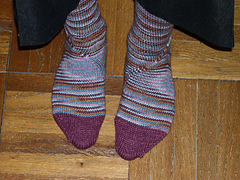
I have to admit that I'm not completely sure about the master numbers. They didn't seem to work for me in this pattern. Coming out of the first toe I noticed that they were going to be too big, so I ripped back and proceeded to tweak the numbers as I moved from section to section. I'll admit that I may have been overzealous in my adjusting of the numbers, but the result was a very short sock (this image shows the second sock unstretched next to the first). They fit well, but only because the yarn is very stretchy and I know that I'm going to be wearing holes in the toe.

It seems that I'm not the only one who had problems using the numbers with the coriolis patterns. I won't give up on the master numbers just yet. I'll try them with one of the other architectures before I determine whether they work for me or not.

* Bartholomew's Tantalizing Socks in my earlier post didn't utilize the master numbers. I knit two pairs using that pattern.

Thursday, April 09, 2009

Booking Through Thursday - Numbers Game

Some people read one book at a time. Some people have a number of them on the go at any given time, perhaps a reading in bed book, a breakfast table book, a bathroom book, and so on, which leads me to...

1. Are you currently reading more than one book?

Yes

2. If so, how many books are you currently reading?
Let me see... The Autograph Man, Fun Home, Jonathan Strange and Mr. Norrell, Little Bee, Miss Zukas and the Island Murders, The Rouseabout, Wolf Girl,... I guess that's six... errrr, seven. (And now that I've pulled that list together I can easily update my "currently reading" sidebar)

3. Is this normal for you?
Yep. More or less. I tend to have a number of different books going at the same time, though I try to make sure the stories are dissimilar so I can keep them straight in my head.

4. Where do you keep your current reads?
All over the place. I have a couple on my desk at work, two on the coffee table at home, one in/on my computer (audio), another in the car (audio), and one in my purse

Monday, April 06, 2009

belated book club reports

Just some quick comments on the last two book's the book club discussed

February -
Devil in the White City: Murder, Magic, and Madness at the Fair that Changed America by Erik Larson


It's always interesting to have a nonfiction selection for book club. People who don't normally show up for meetings make an appearance and we end up with a much more diverse group for discussion.

Devil in the White City is a fascinating read. It's about the Chicago Worlds Fair, specifically architect Daniel Burham's part in making it happen, and the notorious serial killer, H.H. Holmes. Larson also weaves into the story of Chicago during 1890s threads (some smaller than others) about Frederick Law Olmstead, Buffalo Bill, Thomas Edison, and Susan B. Anthony, among others.

Larson may have bitten off a bit more than he could chew, however. While we liked the juxtaposition of the two main stories, a number of us thought that the book would have been stronger if it had been more focused.

March -
The Curious Incident of the Dog in the Night-Time by Mark Haddon


A heart-felt and complex coming-of-age story, Curious Incident is narrated by an autistic 15-year-old as if he was writing a murder mystery in which he's the detective.

This book was one of the best books we've read so far in terms of generating discussion. It was also a surprisingly quick read. We all liked it. We thought Christopher was a very sympathetic character and we appreciated seeing the world through his eyes.

The novel is innovative and important and most definitely worthy of the Whitbread Novel Award.

Thursday, April 02, 2009

Booking Through Thursday - Library Week

I saw that National Library week is coming up in April, and that led to some questions. How often do you use your public library and how do you use it? Has the coffeehouse/bookstore replaced the library? Did you go to the library as a child? Do you have any particular memories of the library? Do you like sleek, modern, active libraries or the older, darker, quiet, cozy libraries?

OK, confession time. I actually don't have a library card for the local public library system. That's not to say I don't use libraries. I do have an NYPL card and I frequently check books out of the libraries at the university. I'm also a huge fan of inter-library loan service.

I do like going to bookstores and browsing and was very much in the habit of using the bookstore as a library for a while, but we have definitely been buying less. We've been getting books through BookCrossing and book trading sites like BookMooch. Now I tend to only buy books if I'm planning to keep them permanently or as gifts.

Many of my childhood memories have to do with the library. I wrote about one of them in this post. Personally I like both "sleek, modern, active libraries" and "older, darker, quiet, cozy libraries" for different reasons.