Wednesday, June 27, 2007

book clubbing in June

When developing the reading list for my book club, one of my primary concerns was on variety - both to challenge us to read outside of our usual genres and encourage pop-ins who might only come to a meeting because we were reading their favorite genre that month (though now that I think of it, we did manage to miss some pretty big genres like romance and horror). In any case, June turned out to be a science fiction month with us reading Pastwatch: the Redemption of Christopher Columbus by Orson Scott Card.

In one of the most powerful and thought-provoking novels of his remarkable career, Orson Scott Card interweaves a compelling portrait of Christopher Columbus with the story of a future scientist who believes she can alter human history from a tragedy of bloodshed and brutality to a world filled with hope and healing.

Even though I was raised on fantasy, I never really got into science fiction. While I do read science fiction occasionally, the operative word there really is "occasionally." Even though I'd heard murmurings about Pastwatch I probably would never have gotten around to reading if it hadn't ended up on our book club reading list. I'm glad that I did though because I did quite like it, particularly its unique combination of historical fiction (one of my favorite genres) and science fiction. I decided that I was going to like Card (who I'd never read before) and Pastwatch, when I read in his acknowledgments: "A complaint to Sid Meier, for the game Civilization, which seriously interfered with my ability to concentrate on productive labor".

Though a number of us found the book to be slow going at the onset, those of us who finished it found that Pastwatch got much better toward the end and that at a certain point we became very invested in the story and needed to find out what happened.

Wednesday, June 20, 2007

The Blood of Flowers

The Blood of Flowers by Anita Amirrezvani

Unabridged audio book, read by Shohreh Aghdashloo

After the unexpected death of her father, a fourteen-year-old village girl is forced to sell the carpet intended to finance her dowry. Faced with the very real threat of starvation, the girl and her mother travel to the city of Isfahan where they are taken into the home of their only living relative, a carpet-maker to the shah. Though she was the best knotter in her village, the girl realizes that she has much to learn. She prevails upon her uncle, who sees in her echoes of himself as a young man, to teach her his craft.

Completely reliant on the goodwill of the uncle and his wife, the girl and her mother are treated as servants. Much to her chagrin, both the girl's carpets and her virginity are used as bargaining chips and traded against future commissions. When the girl fails to see the precariousness of her situation and makes one too many costly mistakes, the damage is irreparable and she must finally take responsibility for her own fate and that of her mother.

The Blood of Flowers is a novel to be savored. Amirrezvani’s writing is sensual and her seventeenth century Persia vividly realized. She blends traditional Iranian folktales seamlessly into a first-person narrative, which is peppered with details on the art and business of carpet-making. The novel’s unnamed protagonist is naïve and headstrong, but eminently likeable. Despite making any number of impetuous and ill-advised decisions, readers can't help but sympathize with her.

Unlike many historical debuts, The Blood of Flowers' narrative is well-balanced: while the historical detail is integral to the plot, it never threatens to overwhelm the story itself.

Actress Shohreh Aghdashloo’s narration never detracts from Amirrezvani’s finely-wrought novel. In fact, her accent imbues the text with authenticity and her voice has a mesmeric quality that draws listeners completely into the story.

The audio version (a sample clip is available on the publisher's webpage) also includes an interview with the author, in which Amirrezvani answers a number of questions about the novel, her background, and her writing process. Of particular interest is the segment about Amirrezvani's decision to not to name her protagonist.
Read my review at Armchair Interviews...

This fabulous novel is on the suggested reading list for the Hidden Treasures read-and-review contest. Pick up a copy to read this summer!

Saturday, June 16, 2007

Hidden Treasures Contest

My friend Susan over at West of Mars is hosting another read-and-review contest. This time, the name of the game is Hidden Treasures.

Here are the basics:

1. Find a book that's a "hidden treasure". That means a book that hasn't made it to a best-seller list anywhere that you can find. A suggested reading list is available at WestofMars.com (some of you will recognize two of my suggestions right away, the other is one that I haven't mentioned here before). Feel free to find your own treasure, though.

2. The book MUST be from a royalty-paying publisher. If in doubt, ask.

3. Read it.

4. Post a review somewhere on the Internet between July 15 and August 15.

5. Sign the Mr. Linky at West of Mars. Include the permalink for your review.

6. Yes, you can use a Hidden Treasure book that fulfills another contest or reading challenge.

7. Yes, you can review more than one book.

8. If, for some reason, you don't want to win a prize, let Susan know.

9. If you have suggestions for the Hidden Treasures Suggested Reading List, or a prize for the winners, drop Susan an e-mail.

10. Prizes will be awarded August 20. Winners will be contacted and winning list will be posted no later than 22 August; be sure to have a way for us to contact you!

For more information, check out this post.


If you have any questions about the contest, feel free to ask me. I look forward to seeing what you decide to read-and-review and you can bet that I'll be playing along as well.

Tuesday, June 12, 2007

BookExpo Canada 2007

My back is sore, my arms are sore. I came back with two huge bags of publishers' catalogs (I'll be posting about exciting fall titles after I've had a chance to read through them) and tons of galleys.

BookExpo was, in a word, overwhelming. Luckily my friend Janelle (reviewer extraordinaire) knew the lay of the land and kept me from wandering aimlessly though the convention center.

I really don't know how to sum up the experience, so here are some of the tidbits:
- I am now the proud owner of a signed copy of The Opposite House by Helen Oyeyemi, who is both beautiful and "cool" and has written two wonderful novels despite being five years younger than me.
- I needed a whole bag just to carry Penguin's catalogs.
- I can't wait to try out some recipes from I Love Coffee!: Over 100 Easy and Delicious Coffee Drinks by Susan Zimmer.
- I kept far away from James Patterson and all the super big name people signing.
- I heard a great interview with Laura Byrn Paquet about Wanderlust: A Social History of Travel, which sounds like an amazing book.
- I ran into a mystery bookstore owner who recommended picking up a copy of The Faceless Fiend by Howard Whitehouse (they were giving out ARCs at the Kids Can Press booth), saying it looked like a winning combination of Artemis Fowl and Victorian England.
- I drool over the Raincoast Books catalogs.
- I shared a lunch table with Rebecca Upjohn. Her first children's book, Lily and the Paper Man, which will be published by Second Story Press this fall. I'm definitely going to buy a copy for my nieces.
- I just finished reading one of the books I picked up at BookExpo, Villa Serena by Domenica de Rosa (expect a little review later this week).

Keep an eye on my library once LibraryThing is up and running again. There'll be some interesting new additions.

Saturday, June 09, 2007

BookExpo Canada

That's where I'll be this weekend. Expect a full report on Tuesday.

Thursday, June 07, 2007

Matters of the Blood

Matters of the Blood by Maria Lima

Rio Seco, Texas isn’t your average small town and Keira Kelly isn’t your average small-town girl. She born into a family of necromancers and at thirty-seven, has not yet come into her powers. Tired of her controlling family, Keira opts to stay in Texas when the family migrates to Canada, even though it means keeping an eye on her annoying human cousin Marty and his mortuary business.

Keira relishes her independence for two years before strange things start happening in Texas Hill Country. Horribly mutilated animals start appearing after a mysterious stranger purchases Wild Moon, a ranch outside of town, and converts it to an exclusive inn. When Marty is found dead on his embalming table with bite marks in his neck, Keira can't explain her true suspicious to the county sheriff because he knows nothing of the supernatural. It's up to Keira to figure out the cause of the recent spate of deaths while fighting off the advances of the sheriff, a former fling. If that wasn't enough, Keira has to deal with an onslaught of vivid and disturbing nightmares, which she recognizes as the first symptom of "the change," her supernatural coming-of-age.

Matters of the Blood starts out with a bang -- “I know the dead and the dead know me" is an intriguing first line if there ever was one -- and maintains a strong pace throughout. The novel has mystery, intrigue, and a number of unexpected twists. There is also plenty of sexual tension. Beyond a satisfying storyline, the novel is buoyed by a strong cast of supporting characters. They include Keira's brother Tucker, a sexy bisexual hellhound; Beatriz Ruiz, Keira's spunky best friend who owns the local café; Adam Walker, an enigmatic love interest; and Boris and Greta Nagy, a pair of Holocaust survivors; as well as a variety of vampires and other paranormals.

One of the things that makes this book stand out is how Lima leaves room for a sequel while still tying things up nicely at the end. Unlike some other paranormal series, this one seems to have been conceived with intent. While the mystery is resolved, the core story remains unfinished. Additionally there are plenty of interesting characters that deserve attention and a whole cast of family members at which readers have only had a peek.

My one complaint about the book is that, especially in the beginning, I really felt like I was grasping at thin air when it came to understanding Keira and her back-story. Upon reflection, however, I've determined that my initial response was a result of the fact that Lima was trying to create in Keira a more full-bodied character that could unfold in future books (something of which I wholeheartedly approve). In short, some readers (like me) will be disoriented at the onset, but if they persevere they will find Matters of the Blood compulsively readable and close its covers hoping for a sequel.

Read the review at Front Street Reviews...

Saturday, June 02, 2007

Greed

My review of Greed by Elfride Jelinek (translated from the German by Martin Chalmers) appeared in the May 1 edition of Library Journal.

Jelinek's latest novel (published in German four years before she won the Nobel prize) is one that will appeal to her fans and most likely infuriate her detractors as well as casual readers previously unfamiliar with her writing.

Set in southern Austria, Greed tells the story of a country policeman with a mania for property acquisition and an appetite for rough sex that leads to the murder of a 16-year-old girl. The storyline, however, is not the important element of this novel. Its driving force is Jelinek's inimitable style of commentary on relationships between men and women, the struggles of the writer and of aging, the state of the environment, and Jelinek's love-hate relationship with her native Austria, among other things. The stream-of-consciousness musings of the novel's unidentifiable female narrator may drive some readers to distraction, with their repetition, lack of plot progression, and often incomprehensible wordplays. Like her or not, this "extraordinary linguistic zeal" is why Jelinek is a Nobel laureate.

Read the proper review at Library Journal...

Thursday, May 24, 2007

book clubbing in May

I for one can't believe that it is almost the end of May already. Where has the month gone?

My book club's monthly meeting took place yesterday. Our selection for this month was: Simon Winchester's The Professor and the Madman (subtitled: A Tale of Murder, Insanity, and the Making of the Oxford English Dictionary). It was another book that we all enjoyed, though maybe not quite as much as we expected to.

I know that my opinion of the book was definitely clouded by the fact that I'd already read (and read relatively recently) The Meaning of Everything, Winchester's other book about the OED. Because the subject of the two books is the same there are passages that seem to have been copy-and-pasted from the first book into the second. That, however, wasn't my complaint. Actually, I just thought The Meaning of Everything was a much stronger book. In The Professor and the Madman, Winchester is trying to tell the story of Minor (the madman) as well as the story of Murray (the professor and longest-reigning editor of the OED) and the broader story of the OED itself. Because he is trying to accomplish so much in one relatively short volume, he doesn't really manage to tell any of the stories satisfactorily.

One of the things I did like about the book (well, both books) is Winchester's use of what in my family we call "SAT words" (in reference to one of the standardized tests that we Americans need to take before entering university). I'm not sure if Winchester made an attempt to use more arcane words because he was writing a history of a dictionary or if he always writes like that, but it's definitely something I noticed and appreciated.

I'm sure that I'll be reading more from Winchester in the future because we have a number of his other books kicking around the house (The Map that Changed the World and Krakatoa are two I've happened across recently). I think that I may try to search out audio versions though as Winchester is a really wonderful reader.

Sunday, May 20, 2007

some recent reading

In addition to the books for which I need to write reviews (I have three reviews in progress and am still reading another book I need to review), I have managed to squeeze in some lighter reading.


Kafka's Soup by Mark Crick
Subtitled "a complete history of world literature in 14 recipes," Kafka's Soup is a light, amusing read. I was intrigued when I first saw the book on the shelf at the book store and was ecstatic when one of my BookCrossing friends had a copy to share (my first instinct about the book--that it would be a fun read, but not worth the cover price--turned out to be quite correct).

In Kafka's Soup, Crick creates recipes in the style of different authors (from Homer to Graham Greene). I particularly enjoyed Tarragon Eggs à la Jane Austen and Coq au Vin à la Gabriel García Márquez--possibly because in those recipes Crick was mimicking two of my favorite authors. I also enjoyed Clafoutis Grandmère à la Virginia Woolf partially because a recipe for that dish appeared in the most recent Williams-Sonoma catalog giving me a wonderful sense of connection. The Marquis de Sade's poussin recipe was amusing, but seemed to drag and left me skimming after the first few pages.

My issue with the book is really with the word "complete" in its subtitle. I just fail to see how fourteen authors (all Western it seems) can illustrate the complete history of world literature.


You Slay Me, Fire Me Up, and Light My Fire, the first three books in the Aisling Grey, Guardian series by Katie MacAlister.

These books are very similar to MaryJanice Davidson's Undead and... books (see my comments on those books). In the Aisling Grey, Guardian series, the protagonist is a guardian (soon to be responsible for her own portal into Hell) and a wyvern's mate (destined to be the partner of a dragon clan head). If you liked the Undead and... books, you'll probably enjoy Aisling Grey and her adventures. I, for one, had a very similar reaction to the books: I had a hard time relating to Aisling (a reaction that did diminish in the later books) and found that the secondary characters (particularly Jim) really made the books.

My biggest complaint about these books is that MacAlister seems to have written them without a plan for how the series was going to progress. There are things that happen in books 2 and 3 that have no grounding in the earlier books. They necessitate huge leaps which really can't be explained away by Aisling just not being in the know (some of them can, but others really can't). Book 3, Light My Fire, is really the first book where MacAlister seems to be laying the groundwork for the rest of the series.

Saturday, May 12, 2007

A Mortal Glamour

A Mortal Glamour by Chelsea Quinn Yarbro

Dark historical fiction set in fourteenth century France, A Mortal Glamour tells the tale of one turbulent year in the life of a convent. Although A Mortal Glamour was originally published in 1985, this new edition--published by Juno Books with wonderful new cover art--includes over twenty-five thousand words cut from the first edition.

Young, headstrong Seur Aungelique (nobly born into the d'Ybert family) enters la Tres Saunte Annunciacion convent rather than marry the man chosen by her father. Stifled by the Rule of Order, Aungelique becomes increasingly frustrated with convent life after the introduction of a strict young superior. Fleeing under cover of night, she takes refuge with Comtesse Orienne, the most accomplished courtesan in France. Though openly admitting her desire to receive tutelage from the Comtesse, Aungelique also seems to have an ulterior motive: to meet her true love Pierre Fornault (Duc de Parcignonne), who she knows to be a patron of Comtesse Orienne. Though she is returned to the convent before she has the chance to commit any real sins of the flesh, Aungelique's appetite for lust has been whetted, an appetite that soon becomes irrepressible.

After her return to the convent, Aungelique begins to experience nightly visitations accompanied by loud moans of pleasure and pain from her cell. No penance, it seems, can relieve her of these visitations: neither performing vigils nor fasting helps and, indeed, scourging seems to exacerbate the problem. Whether demonic or no, the visitations are contagious and soon other sisters, a priest, and even a soldier stationed at the convent are affected. As the convent falls prey to otherworldly chaos, it is left to languish and questions begin to multiply.

The novel’s backdrop is one of desperate, turbulent times. Europe is still cowed with fear of the Black Death. France and England are embroiled in what would later be known as the Hundred Years’ War. And, with Pope Urban VI reigning in Rome and Pope Clement VII reigning in Avignon, the Church is divided and distrust is rampant.

Tied to what seems to be the author’s intended commentary about women’s status (or lack thereof) at that time, what is most horrific about the story is the lack of action by the Church in Avignon. As Père Guibert, the priest tasked with shepherding the convent’s inhabitants, explains the situation most succinctly:
I pray that it is only the perfidy of women that must be corrected and not the incursion of Hell. The Pope has recently warned that the forces of Rome are growing stronger and seek to undermine the proper authority of Avignon and the French throne. To have demons present would weaken his assertion that it is Avignon that is the right. It might be thought that these nuns were acting on behalf of Roman interests, that the women entertain Roman lovers and for that seek to cast doubt upon the sanctity of Avignon. (212)
The Church, it seems, would rather lose dozens of innocent souls than risk a loss of power.

A Mortal Glamour is a compelling read. Though set in a different era, it is similar to Joanne Harris' Holy Fools and will appeal to readers who enjoyed that novel.

Read my review at Front Street Reviews...

Tuesday, May 08, 2007

Queen of the Underworld

Queen of the Underworld by Gail Godwin

Bright-eyed, independent Emma Gant arrives in Miami in the summer of 1959 with the world at her feet. She has a married lover who'll show her the ropes, and a reasonably-priced residence orchestrated by a family friend, and an upwardly-mobile job at the Miami Star, the most important accessory for a recent graduate of the University of North Carolina at Chapel Hill journalism school.

Emma joins the Star's reporting staff at a tumultuous time, shortly after Fidel Castro enacted his First Agrarian Reform. Living in a hotel run by Cuban émigrés for Cuban émigrés makes the upheavals of Castro’s revolución more than just news to Emma. Placing her in this context, the author seems to be drawing a comparison between Emma’s situation and that of the Cubans. As Emma is struggling to figure out her place in the world and gauge her future success, so are her newly exiled neighbors.

The more one reads into the life history of the author, the more Queen of the Underworld begins to seem like a semi-autobiographical novel. Godwin herself graduated from UNC-Chapel Hill in 1959 and spent a year on the staff of the Miami Herald before embarking on the world travels that sparked her literary career.

What is most curious about the novel is that it takes place over such a short period of time. The story of Emma's coming into her own, Queen of the Underworld is a window into what seems to be a key moment in Emma’s development, one that may affect her entire career. Godwin, however, manages to squeeze an unbelievable amount of action into less than two weeks. Emma's life during the span of the novel is so full, it is almost surreal; as she herself recounts, “in one week and three days, I met a gangster walking a dog, sat behind a notorious boss at a funeral, became friends with [an] ex-madame […], and helped two Cubans smuggle arms out of Florida” (331), and that’s not even the half of it.

By contrast, the novel’s ending is unsatisfying and somewhat abrupt. While Emma fantasizes about writing a novel, there is nothing (besides Godwin's own history) that gives any indication that Emma will become a novelist. The narrative ends with both Emma and the reader waiting on her future, filled with unanswered questions.

Godwin’s characterization, however, is the novel’s saving grace. Emma is amazingly sympathetic despite her naïveté and the fact that she seems to have no compunction about sleeping with another woman's husband (although her sexual relationships do seem to be at odds with her history of sexual abuse). More significantly, Queen of the Underworld is full of finely drawn secondary characters. One such character is Don Waldo Navarro, a prominent academic who fled Cuba with his memoirs sewn into his wife’s skirt. A minor character, who could have easily been shunted aside after his grand entrance, Don Waldo is made real in Godwin’s attention to detail: he swims breaststroke in the hotel pool “in billowing maroon trunks” (260) with “his leonine head erect” (259) and has the ability of seamlessly incorporating a nine-year-old Spanish-speaking girl into a English-language conversation: “the great educator’s consecutive translations into Spanish on Luisa’s behalf bore no trace of pedagogy. Don Waldo made it seem merely as though he suddenly chose to complete the rest of his discourse in another tongue” (272).

Read my full review at Front Street Reviews...

Tuesday, May 01, 2007

my daemon


I'm not crazy about having a spider as my daemon, but I took the test twice (once when I first heard about the test and a second time when a friend told me about the cool change-your-friend's-daemon feature) and ended up with a spider both times (my first one was named Inachus) and it seems that it's meant to be. Feel free to see if you can't change the daemon to better suit me.

If you haven't read my comments on The Golden Compass, check out this post.

Saturday, April 28, 2007

some recent reading

I have had a chance to do some lighter reading recently, most notably the first two books in Angie Sage's wonderful Septimus Heap series: Magyk and Flyte.
I read Magyk a couple of weeks ago. I needed something that could help me decompress from a long week and it was just the ticket: a captivating story full of sympathetic characters. I later read Flyte. It isn't quite as good as the first book, but that's to be expected of the second book in a series. I thoroughly enjoyed both books, am looking forward to reading Physik (the third book in the series), and am planning on procuring a copies for my own personal collection (I'd borrowed the books from a friend).

Here's a little passage that struck me as being very apt to my own situation: "Everywhere you looked there were books. On sagging shelves, in boxes, having in bags from the ceiling, propping up the table and stacked up in such precariously high piles that they threatened to collapse at any moment" (Magyk, 21). Things here aren't quite that bad, but we definitely have the same book hoarding problem as the Heaps.


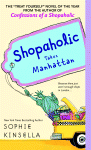
I also read the first three Shopaholic books: Confessions of a Shopaholic, Shopaholic takes Manhattan, and Shopaholic Ties the Knot.
My coworker has been bugging me to read the Shopaholic books for some time. Honestly I was a bit reticent because I know how easy it is to get in debt and the books really seem to trivialize the problem (yes, I know it's chick lit, but a little realism wouldn't hurt... with Becky's spending habits she should be much more in debt than she is in the book).

In any case I finally got around to reading the first few books in the series. They were OK. I actually liked Shopaholic takes Manhattan better than Confessions of a Shopaholic (I'd classify Shopaholic Ties the Knot as more of the same).

Wednesday, April 25, 2007

book clubbing in April

This month my book club discussed The Time Traveler's Wife by Audrey Niffenegger.

I first read The Time Traveler's Wife in late 2005. Here's what I had to say about the book at that time (taken from my BookCrossing journal entry):
What a wonderful book! I was afraid that this might be one of those books that just doesn't live up to the hype, but I was not disappointed.
A love story, an interesting premise, and well-developed, sympathetic characters... what more could you want?
And, honestly, I enjoyed my second reading as much as the first. I really do think that The Time Traveler's Wife is a wonderful book and - come to think of it - I should pick up a copy for my permanent collection.

What was really interesting about our book club meeting today is that we all liked the book and we had a good discussion. For some reason we tend to have much better discussions when we are talking about books we didn't like all that much. We discussed the author and her writing style, how Niffenegger's theory of time travel deviates from the "rules" that govern most time-travel fiction, Henry and Clare as characters and how they acted in certain situations, the implications of Alba's time traveling, and whether or not we found the ending satisfactory among other things. All in all it was a very successful meeting.

Niffenegger is definitely a gifted novelist evidenced by her ability to manage The Time Traveler's Wife's complex plot and present it so seamlessly. I'm very curious to see what her next novel will be like.

Tuesday, April 24, 2007

lately

Lately it seems that I have taken an unintended break from blogging.
I've been strangely unmotivated. Originally this was due to winter's tenaciousness. Then the weather started to get better, but last week happened. I know it shouldn't affect me more than most other people, but if I wasn't here I would have been there... not that it would have made any difference, but still.

In any case, I'll be back tomorrow with my comments on my book club's April selection. Then, with any luck, the usual reviews and comments will start to trickle out.

Tuesday, April 10, 2007

Kabul Beauty School

Kabul Beauty School by Deborah Rodriguez

Deborah Rodriguez, known by Kabul shop owners and Michigan prison inmates alike as “Miss Debbie,” first came to Afghanistan in 2002 as part of a group from the Care for All Foundation, a Christian Humanitarian Organization. A hairdresser by trade, Rodriguez is deemed significantly less useful than her medically-trained compatriots and is given any number of odd jobs and a good deal of free time to explore the city. Little did she--or the relief group--realize exactly how desirable her skills might be in that war-torn city.

When the expatriate community discovers a hairdresser in their midst, Rodriguez is swamped with requests. One woman summed up the situation quite succinctly: “We have literally risked our lives for highlights. […] Once I drove ten hours over the Khyber Pass to get my hair done in Pakistan” (39). During Taliban rule, hair salons and their feminine space were banned. In 2002 salons were only just starting to reopen, struggling without the supplies and skills needed to be truly successful.

As she begins to befriend both westerners and Afghans in Kabul, Rodriguez begins to see a niche that she can fill. She returns to Michigan hoping to find a way to open a teaching salon in Kabul. Armed with her dream and a lot of gumption she manages to get $500,000 worth of donations from Paul Mitchell and other large beauty companies. Just when Rodriguez is at a loss as to how to proceed, she discovers Mary MacMakin and her nonprofit, PARSA. Aligning herself with PARSA, she returns to Kabul in Spring 2003 as a founding faculty member of the Kabul Beauty School, eventually becoming its lead instructor and administrator.

While Rodriguez’s story of an American woman helping to make a difference in the lives of Afghan women is not unique, it is both moving and powerful. Kabul Beauty School is compulsively readable. A strong opening chapter illustrates both the struggles of modern Afghan women and Rodriguez’s inimitable blend of brazenness and kindness, leaving readers with a desire to know more about this spunky, resourceful hairdresser and her students.

The stories of Rodriguez’s students fill the pages of this memoir: the wife of a Taliban-aligned opium addict, the bride who must fake virginity, and the young girl sold by her parents to an older man, just to name a few. The author, however, is just as interesting as her students.

One of the things that sets Rodriguez apart is her ability to empathize with her students. Having suffered an abusive husband, she is attuned to the indignities--both large and small--that affect Afghan women every day. Rodriguez is dynamic and personable; more than that, she clearly loves Afghanistan and its people. As she so elegantly puts it, “as soon as I set my foot on this soil, I knew I’d somehow managed to come home. I’ve been renewed by the spirit of this place and roused by its challenges” (269). While Rodriguez maintains both her personality and independence throughout the period covered in this memoir, she becomes ever more a part of the Afghan community, even allowing her friends to arrange a marriage to an Afghan businessman.

The history of the school--and Rodriguez's life in Kabul--is not without drama. The school has political and financial problems. There are cultural misunderstandings, most perpetrated by the clueless, but well-meaning Rodriguez. At the memoir's end, we learn that both the school and affiliated salon have been closed. Nevertheless, the reader is left with a sense of hope: if anyone can turn things around, it is Rodriguez.

The narrative is a bit uneven (for example, the handling of her son’s stay in Afghanistan is cursory, simply tagged onto a story about one of her students). However, that is almost to be expected in a first effort and the natural charisma of the author, and the compelling tale of the school, will be enough to keep readers interested.

Read the review at Front Street Reviews...

Friday, April 06, 2007

I think of you

I think of you by Ahdaf Soueif

Ahdaf Soueif's first fiction offering since The Map of Love, which was shortlisted for the 1999 Man Booker Prize, is actually a repackaging of nine stories originally published between 1983 and 1996.

Set primarily in Egypt and the United Kingdom, each of the stories features a female character. Throughout the collection Soueif focuses on the interior life of her protagonists and the ordering of the stories lends some sense of a progressively maturing voice. The collection, however, does seem a bit uneven. With the first five stories developing two specific characters, the protagonists of final stories seem comparatively inchoate.

The first three stories--"Knowing," "1964," and "Returning"--show three different epochs in the life of Aisha, an Egyptian woman who immigrated to the United Kingdom in her teens. "Mandy" and "Satan" feature Asya, a woman separated from her husband who dealing in different ways with the repercussions of their broken marriage and his philandering.

In the title story, which is arguably the collection's strongest, the unnamed first-person narrator has been hospitalized due to a high-risk pregnancy. With her husband in London unable to get a visa and her family in Cairo, she is alone, the only patient not observing purdah. She survives her hospitalization by invoking an elderly friend, confidante, and role model who died of cancer.

If the stories have a unifying theme it is that of estrangement; estrangement (both emotional and physical) from husbands, as well as from the homeland and the culture of one's childhood. While I think of you lacks the refinement of Soueif's later work it is nevertheless worth reading. Her stories are touching, nostalgic, but never overly so. Soueif's prose is lyrical and this collection is buoyed by her ability to give her readers an extraordinary sense of place.

Read the full review at Armchair Interviews...

Wednesday, April 04, 2007

River Secrets

River Secrets by Shannon Hale

The whole of Bayern is ill at ease when its king and queen decide to send a delegation to Tira, a rival nation that attempted to conquer Bayern the previous year. The losses incurred in that campaign’s final battle, most as the result of a Bayern fire speaker, have only fueled tensions between the two countries. No place is more dangerous for Bayerns to travel than the Tiran capital Ingridan, but King Geric and Queen Isi are convinced that a diplomatic mission is necessary to avert further conflicts. River Secrets is the story of one young Bayern, Razo of the Forest, and his role in securing peace with Tira.

When Captain Talone announces the twenty men selected for the ambassador's guard, Razo is astonished that a substandard soldier like himself has been chosen to be part of the elite group. While he is a member of Bayern’s Own, the king's personal fighting force, he is probably its most incompetent member. Regardless, Razo relishes the chance to be a part of the adventure and to keep an eye on his friend Enna, the fire speaker who puts herself at personal risk by joining the delegation.

Facing pressure from its citizens, the Tiran assembly has agreed to a fall vote on whether to go to war with Bayern, leaving the ambassador only a few months to convince them otherwise. When burned bodies start to appear - seemingly placed to incriminate the Bayern delegation - the group realizes just how impossible their mission is. In addition to convincing the Tiran assembly to vote against war, they must figure out the mystery of the burned bodies without implicating themselves.

The tense political situation between the Tira and Bayern is handled masterfully. Throughout the novel, Hale is able to balance the two competing fantasy cultures, highlighting their differences and similarities, and in the process saying some profound things about both their world and ours. One such profundity comes early in the novel from the mouth of Queen Isi: "It's easy to believe that complete strangers are your enemies" (18).

River Secrets is well-plotted, mixing action, mystery, and romance in just the right combination to perfectly satisfy readers. Hale's writing is lyrical, her characters enchanting. A page-turning adventure, River Secrets is also a touching coming-of-age story. At the beginning of the novel, seventeen-year-old Razo is insecure. Still reeling from the loss of his first love to another man, he can't see beyond his obvious failures to the unique talents that he does possess. It is only when Razo is able to see himself through the eyes of others that he begins to realize his potential. Young adults - especially those going through an awkward phase themselves - will have no problem relating to the novel's endearing protagonist.

Although this book does follow Hale’s The Goose Girl (2003) and Enna Burning (2004) - Razo is a secondary character in those two novels - it does stand alone. While many fantasy enthusiasts will want to immerse themselves in Hale's fully-realized world by reading all three novels, knowledge of the earlier books is not necessary to enjoy River Secrets.

Read the full review on Curled Up Kids...

Monday, April 02, 2007

Happy BAFABW!

Happy Buy a Friend a Book Week, everyone!


Celebrate this week and buy a book for someone you love (or someone you just like).

Wednesday, March 28, 2007

book clubbing in March

This month my book club discussed The Golden Compass, the first book in Philip Pullman's His Dark Materials trilogy.

The Golden Compass is a young adult book that can definitely appeal to adults as well. Everyone in my book club enjoyed the book, even those you generally shy away from fantasy and young adult books.

I think one of the things that sets The Golden Compass apart is how Pullman is able to present this wonderfully complex world, one that is very much not our own, but that bears enough resemblance that things feel familiar. One of Pullman's best inventions is the daemon, a physical manifestation of each character's soul in animal form (when the characters are children their daemons are continually changing form, at puberty the daemons set for life).

The Golden Compass includes a wonderful array of characters -- including witches, child-stealing "Gobblers", armored bears, absentee parents, evil scientists, and ship-going gypsies -- and an interesting plot.

The novel is a page turner and readers quickly become invested in protagonist Lyra and her quest. Once I read The Golden Compass, I had to continue the series so I also read The Subtle Knife (definitely the second book in a trilogy, somewhat disappointing) and The Amber Spyglass (a good conclusion to the series, satisfying).

If you haven't read these books, I'd encourage you to pick them up. They're not perfect, but they are good reading. I don't want to say too much more for fear of giving too much away (I had to zip my lips a bit at the book club meeting precisely because of that). A few more descriptive words should suffice: unique, subversive, enchanting...